A film that came out last year with a pretty decent cast,
Lawless is the latest in a long line of films of 2012 that I missed
because I've got much more into playing online computer games in the
last 12 months. The film tells the story of the Bondurant brothers, who were
bootleggers in Virginia during the prohibition era of the early 1920s.
They ran a rural bootlegging empire that competed with the big boys of
the major US cities and appeared to be largely ignored by the
authorities because of its small-time and relatively unviolent nature.
That is until the uncompromising big city fed Charlie Rakes gets
involved (Guy Pierce), who makes it a personal mission to take the
brothers down.
I said that Lawless has a 'pretty decent' cast,
and while the inclusion of Gary Oldman, Guy Pierce and Jessica Chastain
gives a healthy heap of gravitas to proceedings, the problem is that
they don't really get to do a lot. Instead we have Shia LaBeouf and Tom
Hardy (aka Bane) going full redneck as they run around the dusty scenery
shooting guns, fighting with small-time criminals and buying off the
cops. I've not been impressed by LaBeouf's acting to date, and though it
would be harsh to judge Hardy by the incomprehensibility of Bane in
Dark Knight rises, his character here rarely gets out of a rough
rumbling gurgle of speech. Maybe that all he can do? What I'm saying
here is that I felt a little cheated out of what was a potentially
brilliant cast. Gary Oldman stands around looking menacing for a bit
but has literally no impact on the story, Guy Pierce gets to be all evil
- but it's nothing more than cardboard cut-out 2D evil - and Jessica
Chastain just stands around cleaning glasses and looking angelic. It's a serious waste of talent.
There's not much more that gets on my wick in
films than female characters who are there for window dressing. Here
our lady characters are played by Chastain and Mia Wasikowska
(she was Alice in Tim Burton's recent Alice in Wonderland). As I've
already said, Chastain does little more than have big eyes and white
skin and stand around representing purity. Wasikowska
plays an innocent country girl who's there to tempt LaBeouf's character
away from his family and into the non-criminal world. I guess the
point of her is to show the audience that despite being a
'master criminal', LaBeouf's character isn't actually a bad person. Rather he's a nice normal guy driven to extremes by absurd government
regulation. Fair enough, but I can't shake the feeling that both these
characters were added after the first draft of the script went through
editing, and someone said "hey, there aren't any women in the film -
better add some...". And so we end up with a couple of entirely flaky female characters, ethereal-looking creatures waiting to be rescued from
their torment by our 'heroes'.
The film gets bonus points for
being relentless in its bloody action when the action finally gets
going, there's a lot of blood and pain and general terror when people
are shooting guns at each other. This is about it though. The superb
cast is underused and the film feels like an 18-rated pantomime complete
with unrealistic characters and even an "it's behind you" moment. I'm
not upset I missed this at the cinema.
Tuesday, 12 February 2013
Friday, 8 February 2013
Winter's Bone
Recommended to me at Christmas by someone in my
family (see I do listen to you guys, I just can't remember who said
it), a rental copy of the DVD of Winter's Bone entered my possession
late last week. Winter's bone is the story of Ree (played by Jennifer
Lawrence) and her small family. Ree is 17 years old, but her father is a
drug dealer gone AWOL and her mother has lost her mind, so Ree is
responsible for herself, her mother and two younger siblings. When
Ree's father vanishes after putting their house up as bail money, the
bailiffs tell Ree that she has only a week to get out. That is of
course unless she can find her father - alive or dead.This is clearly the film that landed Jennifer Lawrence the role of a young lifetime in The Hunger Games. In Winter's Bone she plays a very similar character in a similar-looking world. She is young, innocent-looking but mentally tough and wise beyond her years living in an uncaring and harsh rural environment. As Ree starts to search for her father she quickly comes to realise that he was involved in some nefarious business deals in the local community - a closed place where blood is thicker than water and you pay a heavy price for betrayal. Ree receives a number of beatings, both physical and psychological, as she tries to penetrate this community in search of the truth about her Dad. It's a journey that takes incredible strength, all at the same time that she's trying to be a parent to her young brother and sister. Lawrence plays the role by giving a calm inner strength to her character, it's an excellent performance that clearly went noticed amongst Holywood casting directors.
It's a compelling story that's about how you don't have to be waving a sword and giving grand speeches to be a hero. Ree does neither of these things, and the crux of the film comes when she goes to an army recruitment centre to try to sign up for the $40,000 bonus advertised on posters. The recruitment guys tells her that the army wont be any good for her, and that she needs to be strong and brave to stay with her family. It's a scene that feels a little awkward (apparently it was filmed using a real army recruitment officer rather than an actor) but is important - there's nothing easy about running a gauntlet of fear set up by local gangs in search of a better life, and equally there's nothing easy about being a single parent.
Thursday, 7 February 2013
Timecrimes (en Espanol - Cronocrimines)
It's a very long time since my friends and I organised a 'weird film night', but in that tradition stretching back several years we watched the low budget science fiction oddity Timecrimes on Tuesday evening - or in its original Spanish, Cronocrimines. As indicated by the title, Timecrimes is a time travel film in which a simple man stumbles into a situation that makes no sense, then ends up travelling backwards in time half a day and committing a bunch of crimes. The strange events of the day begin to make sense as he experiences them from a different point of view, and Hector (pictured) slowly learns more than he ever wanted to about himself and travelling in time.
Hector is a funny character. He's a bit of an idiot who gets things wrong and bumbles around not understanding what's going on. The film's quite funny because of him and doesn't feel like a lot of science fiction films where the characters get all worthy when they realise the cosmic enormity of what's happening to them. Hector acts like he's never heard of time travel before the scientist guy running the time machine tells him not to disturb anything that happens during the day he's about to relive. He then flips between doing everything he can to make the events of the day pan out precisely the way he remembers and trying to stop bad things happening.
The most interesting thing about Timecrimes is that the film is probably the only completely internally consistent time travel story I have ever seen. By internal consistency I mean that though as a viewer we experience events in the film multiple times (from the point of view of Hector), nothing actually changes. Basically it would be possible to re-cut the film in strict chronological order and everything would still make sense. The opening scene would be Hector emerging from the time machine and then we would see the day's events unfold as multiple versions of Hector run around doing things that only make sense once you know what happens in the future.
Though this seems like a fairly obvious concept, the fact that I can only think of time travel films in which a protagonist changes something about the past means that it must be novel. The story challenges the typical human concept of causality, and idea that we are free to change and do what we like in the world. After Hector travels back in time he spends ages trying to do things exactly like he remember seeing them earlier. What would have happened if he had done things differently or deliberately tried to mess things up? Perhaps the answer is that it's impossible to do things differently. Does a world in which time travel is possible negate the concept of free will? The film suggests that the idea of multiple worlds (so beloved by time travel story tellers who want to have their cake and eat it) is bunkum, and that time only happens 'once'. If you travel in time you simply get to experience events from a different point of view. Therefore the question 'what if Hector did things differently?' makes no sense, because events only happens once - free will as we think we understand it ceases to exist.
After the film ended a healthy but heated argument broke out between two groups of people in the room, those who agreed with me and those who thought the opposite. The fact that this 85 minute long film with limited dialogue and a weirdo for a protagonist can generate such a high-brow debate is big kudos for it. It comes to you recommended.
Wednesday, 23 January 2013
Dark Shadows - Plot? What's a plot?
There was intense excitement at my workplace about 2 years ago when it became apparent that there was a large film crew on site constructing a series of sets that were barely visible from our car park. A large crane appeared and intensely bright lights were visible long into the evening. The loosely-kept 'secret' information about what was going on gradually seeped out from those in the know, apparently this was a Hollywood production. Not just any old Hollywood production, but a Tim Burton film called Dark Shadows starring - obviously - Johnny Depp. Depp generates a well-deserved level of excitement whenever he appears in anything, and no less so for this as rumours flew around the site as to when he would be here and where he was staying in the local area. How much time he spent here is unknown, but when watching Dark Shadows there were scenes of the film that were clearly shot on our 'small roads system' here at TRL. Some of these scenes had Mr Depp in them, so he was clearly here at some point. Yay us!
Sadly this was the most exciting thing about Dark Shadows. At first I was worried that my constant vigilance for places and locations in the film that might have come from TRL was getting in the way of me following the story. But soon I realised that this is a film without a story. It does kind of have a premise though, which is that Depp plays Barnabas Collins - an 18th century man who is cursed to be a vampire for all eternity by a witch (Angelique Bouchard - played by Eva Green) whose advances he spurned for a lowly cleaning girl. Barnabas is excavated from his living tomb in the 1970s and suddenly is thrown into the modern world, a world he doesn't understand.
And that's kind of it. Angelique is now a successful business woman (apparently witches live forever too?) and the Collins' family are now wealthy land owners in the town. So Barnabas seeks his family out, convinces them to take him in and then mooches around being confused by the 1970s until Angelique starts trying to seduce him again. Then he falls in love with the modern equivalent of an 18th century cleaning girl and everything happens again. I think that's it anyway. At some point Barnabus tries to become human again, but that doesn't work. Then for some reason it all ends in a big battle where statues come to life and Chloe Moretz is a werewolf and Helena Bonham Carter tries to be a vampire for some reason. It's also got Michelle Pfeiffer in it, which just had me wondering when it was I last saw here on screen. But she doesn't become a vampire.
It's a complete shambles of a film; a washed up gothic fantasy about tragic lovers, eye shadow, opulent hair, pale make-up and heaving bosoms with only the thinnest attempt at a plot or character arc. Comic moments arising from Barnabas' misunderstandings of the modern world are few and fleeting. Johnny Depp is an accomplished actor, but I think he needs to start reading Tim Burton's scripts before agreeing to be in absolutely everything he directs.
On the plus side though, I do like the Brady Bunch style poster I've stuck at the top of this post.
Monday, 21 January 2013
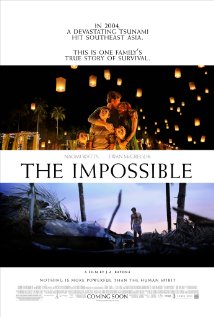
The Impossible - except that it really happened
Did my first cinema trip of 2013 Sunday last weekend when I got home much earlier than I was expecting to from a trip up North to visit old university friends. Cycled in my hi-vis jacket in the biting cold up to the Winnersh Showcase where I a choice between Les Miserables and The Impossible. Now although I do want to see "Les Mis", 2 hours 45 minutes is more than a little off-putting (especially when I wanted to get home to watch the NFL playoffs), so I went with The Impossible.
The Impossible tells the real life story of a Spanish family (cast as British here allow them to use native English-speaking actors) who were on holiday in Thailand when the Indian Ocean tsunami of Christmas 2004 happened. They were staying in a beach-side resort and were hit by the brunt of the huge tidal wave as it crashed down upon the unsuspecting Thai island. The family survived the initial wave but were split up and some of them were seriously injured. The film tells the true story of the various family members' journeys to reunite with the others amidst the carnage of that natural disaster.
The film breaks down into 3 major acts, the tsunami, the aftermath and the rebuilding. The major set-piece is the tsunami. The director and special effects crew have done an outstanding job of bringing a terror that I can only imagine to screen. We see the tsunami from the point of view of Watts' character. We see her helplessly dragged underwater, then tossed like a toy doll into cars, trees and debris as she can do nothing to prevent the onrushing water taking her and everything else where ever it wants. We hear the ominous sounds of the water approaching and share in the terrifying groaning and creaking noises after Watts' character is submerged and tossed around by this destructive phenomenon. The director uses wide panning shots sparingly, but when he does he captures the incredible scale of the tsunami's destruction. It's an outstanding sequence that uses audio and visual special effects, but relies on Watts and Tom Holland (who plays one of her sons) to provide a human reaction to it. It's a reaction of uncomprehending terror, in which neither nature nor nurture can prepare anyone for.
After that, the film settles down into a pattern of people fighting to overcome adversity. Watts' character is gravely injured and helped by local people to a hospital. McGregor's character is physically fine but mentally destroyed by the loss of his wife and eldest son. Ewan McGregor and Naomi Watts are brilliant in their respective roles here. McGregor has taken some questionable roles in the past, but when he's on form he's a great actor. It would take an extremely cynical person to not be moved by the sequence in which McGregor's character borrows a phone to call home. All his emotions are released in one moment as he finally has to admit to someone that he has no idea where his wife is. I didn't realise before that Watts was born in England, which probably helps to explain the flawless English accent she puts on in this film.
There has been some criticism in the press that The Impossible largely ignores the plight of local Thai people in favour of depicting the distress of wealthy European tourists. The family are no doubt extremely wealthy, but I don't have a problem with this as their story is true and amazing so there's no reason not to make a film about it. It would have been nice for the film to have had some sort of epilogue that told us a bit more about the local people and the sheer number of Thais who were killed though. My other criticism would be that there's a very slight anti-American moment (basically the only American we ever see has an unhelpful 'me first' attitude), not sure what the point of that was.
I think that these are extremely small nit-picks though, and overall The Impossible is an excellent film of a very real human suffering and hope against all odds. Excellently acted with outstanding effects, it's a great way to embark on my journey through 2013 in film.
Wednesday, 16 January 2013
Brave - not just for teenage girls & their mums!
The 'Pixar film' of 2012 was Brave. I never went to the cinema to see it as it didn't really generate the excitement in me that Toy Story 3 or Up did in recent years. Perhaps it was something to do with the reviews of the film. They told me that Brave was for teenage girls who can't get on with their mothers, anyone who has ever been a teenage girl and is ashamed by just how much of a brat they were to their mother, and mothers of teenage girls struggling to work out what they're supposed to do. I don't fit into any of those categories.
Brave is set in a Scottish medieval fantasy land, a land of kings, queens, princes & princesses; a land where there are will-o-wisps and witches and spells that can turn people into bears. The story is of Merida (voiced by the always-excellent Kelly MacDonald), a brash tomboy of a princess with tumbling red hair, who loves nothing more than charging around on her horse shooting arrows. Merida is constantly at odds with her mother, who spends most of her time trying to get Merida to act like a princess and preparing her for the day when she will be given away to a prince. All the while Merida's father spends most of his time eating, drinking and telling tales about how he lost his leg to a bear. When the time comes for Merida to marry a prince, she doesn't want to and will do anything to stop her mother getting her own way.
Rarely have a seen a film that so obviously pulls at the viewer's heartstrings than Brave. You've got the strings fading in and out like nobody's business and in the final 20 minutes of the film it's one teary scene after the next as Merida is forced to be responsible and comes to realise that her mother actually loves her, and that she loves her mother back. Not only that, but she would do anything to protect her. I can imagine the teenage girls and their mothers welling up in the aisles. I would be lying if I said I was emotionally unmoved by the story, it's just so well-constructed.
Like all Pixar films, Brave is visually stunning with astonishingly lifelike faces on the characters and sweeping vistas. It's not only the big things, it's the attention to detail too. Small things like individual strands of grass swaying in the wind or Merida's messy hair falling around with a life of its own, these all took someone time to animate. The effect is outstanding.
Brave is hardly Toy Story or Up, but that's hardly a criticism. One real criticism might come from the people of Scotland. Are Scottish people tired of the stereotypes yet? There are scenes of highland games and people fighting-as-a-national-pastime and one character who's a totally incomprehensible Glaswegian. I've only been to Scotland once, and that was Edinburgh - so maybe that's what the rest of Scotland's really like? Anyone from Scotland care to comment? Well there are plenty of Scots here at work so maybe I should ask one of them. On the upside, at least they got some real Scottish people to do the voices rather than Mike Myers hamming it up a la Shrek.
Crucially though this is yet more proof that me and my housemate Rich have utterly opposing view on films. There's a barely a film that passes by upon which we have convergent views. When he saw I had Brave on DVD he gave me the 'oh dear' eyes and warned me it wasn't any good. I thought perhaps this would finally be the one we agree one; after all this is a film that's meant to be for teenage girls and mothers of teenage girls. I guess I've got more empathy for that demographic than Rich does then, because I thought Brave was a fine film.
The Impostor
A very interesting documentary about a man who successfully convinced a Texas family that he was their long lost son. Despite having different hair and eyes, and not even speaking English as a first language (let alone not being from the USA), Frédéric Bourdin managed to convince the entire Barclay family that he was in fact their son Nicholas - who went missing 3 years previously.
The film raises very Interesting questions of both Bourdin and the Barclays, and of what really happened to the real Nicholas. If Bourdin was so obviously not their son, why on earth would the family accept him so readily? At the same time though, given the mental anguish the family had suffered, the desire for relief and for the return of Nicholas was so strong that perhaps they were willing to accept anything. Interestingly, rather than being repentant in retrospect, Boudin goes on the offensive and accuses the Barclay family of knowing more than they claim to about Nicholas' disappearance. Maybe if the family know something untoward about Nicholas' disappearance, and they thought that any move on their part to doubt the validity of Bourdin's claim to be their son would be viewed as a guilty admission that they know he's not coming back!
The documentary superbly mixes up recreations, interviews with people involved and real footage to tell its story. Bourdin is providing a voice-over to his actions almost from the very start of the film, and as such it makes unusual viewing. After all, how often do you see a documentary about a historical crime in which the criminal provides you a voice-over insight into what he was doing at the time? Similarly there are interviews with Nicholas Barclay's sister and mother, both of whom are invited to look back upon the time when they allowed themselves to be taken in by Bourdin's lies and comment on how they felt and feel about it.
One of the best bits about the story is that there is still no resolution at the present time. Bourdin has served his time and moved on with his life while the Barclays still don't have Nicholas back. The private investigators in San Antonio who can be bothered to are still looking for Nicholas, some are even prepared to entertain the idea that the Barclays were involved in foul play in his disappearance. It's a real life modern Machiavellian tale involving real people, that's still going on, and is utterly gripping.
Subscribe to:
Posts (Atom)