Wednesday, 31 October 2012
Skyfall
Went Monday evening to a very busy Showcase in Winnersh to see Skyfall - the 23rd official film in the Bond series. After the debacle that was Quantum of Solace I was very pleased to read and hear near universal praise for the new film.
As a Bond film, Skyfall is superb. The plot is simple and direct, the bad guy is a normal person motivated by revenge, there are grandiose set piece action sequences and a plethora of nods to the last 50 years of Bond. Purely as a film though, Skyfall does have problems, but no criticisms that couldn't also be directed at the 22 preceding films. The story is simple: while on a mission to Turkey to recover a computer containing the names of undercover NATO agents, Bond - played superbly by Daniel Craig - is accidentally shot and presumed dead. He resurfaces only when MI6 comes under attack and it becomes clear that someone with ties to M - the ever-excellent Judi Dench - is pulling the strings and responsible for realising the information Bond was trying to recover.
Bond here is Bond as I always hope it will be. No gadgets, cheesy lines and raised eyebrows; no invisible cars, double-taking pigeons or "I think he might be attempting re-entry" lines. What we have is Bond as the hard-as-nails loner, the drinking womaniser who does whatever job his superior tells him to without remorse and kills without pity. This is a character who should hardly be capable of feeling anything given the number of people he has killed and the betrayal he suffered in Casino Royale; in Skyfall this is the case. When presumed dead we see Bond living a dead-end existence drinking and screwing around without passion. The only thing that can re-ignite any semblance of feeling inside him happens when MI6 - and M specifically - are under threat. And it's this that really makes the story and film, since it's a story about Bond, M and their relationship. It's a Bond film that's also a character drama, with the drama being about this central relationship. As much as M tries to behave dispassionately around Bond, it's clear that she sees him as something of a son. And the same applies to Bond as he tries to convince himself and others that he hates M - whereas she's probably the closest thing he's still has to a friend.
I said the film has a few problems, and I'll briefly cover them here. There are a couple of plot holes and things that are a little too convenient. At one point our bad guy Silva - Javier Bardem - uses a train crash to try to kill Bond. Though this is no doubt a great special effect, it relies on Bond being in exactly the right place at the right time. For something that must have taken ages for Silva to set up it is far too convoluted a way to kill Bond - even for a Bond villain. Plus there are no passengers on the train. I suppose you could argue that it's simply a train running without passengers, but this happens in the middle of the rush hour and so is hardly likely. The real reason is that in order to retain a 12A certificate the film has to shy away from showing the ramifications of the violence it portrays. This happens earlier in the film when someone is shot in the head by a sniper - and no blood can be seen anywhere. I understand that the BBFC rules are in place because people don't want children to see blood and people being killed in a train crash, but isn't it more dangerous to bring up a generation of children who are being conditioned think that such violent acts don't have violent consequences? It's a debate for another time I suspect, and Skyfall is hardly the only action film to be edited in this way, but sugar-coating some elements of realism in a film like this undermines a lot of the other realism that they're clearly trying to create.
The occasional film goer will enjoy Skyfall - the Bond aficionado will likely love it. There are probably more nods to Bond lore than I was able to pick up, but the obvious ones included homage to 'Live and Let Die' (escaping off a reptile's back), Q's disparaging remarks about exploding pens and the big one - the Aston Martin. I suppose it doesn't take a genius to write this stuff, but it takes a lot of care and skill to do it with such aplomb. The film holds back on using the classic Bond guitar theme music until the moment that Bond reveals the very same Aston Martin that appeared in Goldfinger - including ejector seat and machine guns. It's a simple moment that's perhaps a little hammed up, but it was the moment when I gave into any nagging doubts and embraced the film.
It's not as good as Casino Royale, but then I'm not sure any Bond films will ever be able to surpass those heights. Skyfall is an exceptionally good Bond film, a good film (it just passes the Bechdel test - and given that Bond films are traditionally a byword for misogyny that's good progress) and just great fun. I'm glad it has opened so well in UK cinemas and hope it does equally well when it opens in the US next month.
Friday, 26 October 2012
The Dictator - sort of half a film
Well I know I said that the next review would be Skyfall, but after my Thursday evening football was called off last night I had a few extra hours spare and so I was able to fit in Sasha Baron Cohen's The Dictator. Cohen plays Hafez Aladeen, the supreme leader of the made up nation of Wadiya that lies sort of where Somalia should be in the real world. Aladeen is a mentalist dictator kind of in the role that Uday Hussein might have been if he had lived. He and his trusted adviser Tamir - Ben Kingsley - must travel to New York to deliver a speech to the UN about nuclear weapons and arms inspectors and all that jazz. So basically the film's that classic Hollywood story about a yokel who travels to New York City, except this time the yokel is Mahmoud Ahmadinejad.
The film has a funny opening and a funny ending, but in the middle it feels like the writers sort of only had two ideas and are just padding out the minutes between the funny bits. The opening is a series of skits set in Wadiya that lampoon many of the dictators who have moulded themselves in the shadow of Colonel Gadaffi. These are funny scenes. One scene in particular involves Aladeen inspecting his nuclear weapons capability with the eyes of a retarded child; another scene stars an extremely sporting Megan Fox who plays herself whoring her body out to Aladeen for a horde of expensive trinkets. The end of the film has Aladeen deliver a speech in the UN about the benefits of having a dictatorship - which are all things that the Americans have already (1% of the population owning all the wealth, media controlled by a few powerful individuals etc). But that's it really, the remaining hour of the running time is padding that they had to come up with to justify a feature length film.
Much of the middle of the film is full of cringe worthy attempts at toilet humour. There is a scene in which someone has to explain to Aladeen how to masturbate. Yep - really. There is another scene in which Aladeen and his nuclear scientist Nadal have an Arabic conversation in a helicopter over Manhattan in which they accidentally hilariously slip in English words like Bin Laden and 911. Just imagine how hilarious that is. Plus there's all the politically incorrect stuff Aladeen can say, about women being inferior to men, Jews being inferior to Arabs and most other kinds of stereotyping you can imagine.
It's only half the film it promises to be; I was excepting a searing attack on the modern Arabian patriarchal dictator. Instead it has a half-arsed go at doing that while appealing to a mass audience by doing a shed load of hackneyed gross-out jokes. It's good that the film is only 80 minutes long, because it made it worth watching in spite of it falling short of doing what I expected of it - and I assume short of what Cohen expected of it too, since he seems like a clever guy.
Well anyway, the next thing I write on here will definitely be about Bond.
Thursday, 25 October 2012
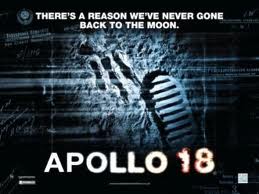
Apollo 18
A depressingly tedious film that doesn't understand its own premise, Apollo 18 is yet another 'found footage' thing in which this time the footage was taken by the crew of the Apollo 18 mission on humanity's last ever trip to the Moon. For some reason the crew of Apollo 18 film absolutely everything they do up on the moon including when they're sleeping and having their miraculously able-to-zoom-and-focus-by-themselves cameras on all the time outside the ship when there's 'nothing' to film. Sigh.
I actually saw the real Apollo 18 when I visited the NASA Space Centre in Houston last year. They have the unlaunched rocket and the command module on display in a humongous hangar to demonstrate just how large the Saturn 5 rockets really were. It's an impressive display and something that anyone who finds themselves in South East Texas should check out. One of the kids on our tour did ask the tour guide about 'what really happened to Apollo 18'. The guide batted the question away with some skill, and I followed up with a question about NASA's research into the next generation of rocket engines. I think he preferred my question.
So the idea here is that the reason Apollo 17 was the 'last' moon mission was because there is some kind of alien presence on the moon that manifests itself in the form of moon rock and dust. So Apollo 18 is some kind of half-suicide mission to the moon to find out what's going on.
It's tedious as there's no tension and the premise is undermined at every turn by the style and content of the film. If Apollo 18 was the final moon mission, how did the footage get found? They wouldn't have transmitted it as it was being filmed as a) no one would ever do that and b) anyone listening in on Earth would have been able to record it. So someone would have had to go to the moon to get it. The film also makes the classic mistake that so many badly-made found footage films make, which is to forget that the cameras are part of the story. What this means is that you can't have a wide-angle establishing shot for a scene unless there's a character in the film who has a reason to go and take a wide-angle establishing shot. There are a number of shots in the film taken from an angle and position at which it would have been impossible to take or position a camera within the context of the story. Though this may sound like tedious nit-picking, what it does is break down the 4th wall and remind you that this in fact isn't a found footage at all. It makes the director and editor look lazy for not realising that their artistic decisions are undermining the premise of the film. It just makes the whole film look rushed and like no-one cared.
Should be going to see the new Bond on Monday next week. Trailers look good, so here's hoping for something that gets back to the heights set by Casino Royale.
Tuesday, 16 October 2012
Air China
So the reason I had a large gap in my posting recently is that I've spent two weeks out of the last month in China having a holiday. I wont bore you with any clever anecdotes because 1: I don't really have any and 2: you're not read this to read about my holidays are you? Thought not. In short, China's very big and there's a lot of pollution, loads of people, some wicked food and terrible driving. Plus the sights are amazing.
Anyway, I watched 4 films on my various plane trips on Air China in the last few weeks. The selection was very poor and so I had to pass the time watching a couple of films I've just watched recently - 'X Men First Class' and 'Hunger Games', good on an 8 inch screen too it turns out. Aside from the healthy selection of terrible-looking Chinese films for some reason the 'entertainment' system had Citizen Kane. First time I've watched that for over a decade, still as powerful as ever exposing of the ultimate fragility of the so-called elites of society.
The only new film I watched was a twee little British / Indian film called "The Best Exotic Marigold Hotel", starring Judi Dench, Tom Wilkinson, Maggie Smith, Bill Nighy and a series of other well-known British actors. It's all about a group of older people who decide for various reasons to go off to India to seek out a fresh start to life / find somewhere peaceful to die - but they all learn something about life. It's a charming enough film with moments both touching and funny, but more than any of that of all it's pretty boring without any real storyline. I would have liked to like the film more - the cast is awesome after all - but it's a mash up of small story lines, none of which provide enough interest by themselves to make the overall film interesting.
It's a shame that the film experience on Air China was so indifferent, as normally a long haul plane flight is an opportunity to sit back and watch a couple of films I might never normally bother with. Half the films were terrible-looking Chinese cheese festivals that looked like they'd been directly remade from a Hollywood scrap heap, the rest were mainly the original Hollywood versions of said films. They did have Cleopatra as an option - which would have been fun as for years it was the most expensive film of all time adjusting for inflation - but even on a 10:30 hour plane ride I couldn't bring myself to commit to 4 hours of running time. Plus I was annoyed by the control system for the interactive entertainment. There was just one button to move a cursor around a screen and a second button to select options. Epic fail.
Air China wont be my airline of choice if I fly back there in the future.
Friday, 12 October 2012
The Woman in Black - wait, I saw a play called that once...
So here we go then, Daniel Radcliffe's post-Potter film career starts here with a Hammer films adaptation of the popular horror novel and play 'Woman in Black'. Unless you've been a in a cultural backwater for over a decade now, you'll know Radcliffe from his role as the wand-toting teenager Harry Potter. With the final film out of the way last year it's time for the lad to move his career on. I can't think of another young actor who as ever been as type cast as Radcliffe must be right now. I'm not sure that ever in the history of film has anyone been cast into such a well-known role at such a young age, and then spent a decade of his formative years playing the same character across 8 feature length movies. The world has literally watched Radcliffe go through puberty on screen. If he can get on with the rest of his life in any sort of normal way it will be a minor triumph for him.
His first major role after Potter is an interesting one for him. I can imagine the thought-processes of him and any advisers he has - get away from the fantasy genre & play a non-teenager. Hammer films might traditionally sit in the fantasy genre, but not here as The Woman in Black is a ghost story similar in feel and setting to the recent 'The Awakening'. Radcliffe plays Arthur Kipps, a young man eager to prove his worth to his firm by travelling to the spooky reaches of the English North East to sort out the estate of the isolated house of a deceased family. Certainly not an awkward teenage character by any means. Kipps spends time at Eel Marsh house and has a variety of other-worldy encounters, eventually becoming convinced that the dead ex-resident Jennet Drablow is the mysterious Woman in Black - who haunts the house and kills local children.
There's a way to make a horror film and I am surprised that whoever had the vision for this doesn't seem to get it. Surprised since the film was made by Hammer studios - who are sort of well-known for horror films. The biggest problem that a horror film can have is if it isn't scary, and endless scenes of Daniel Radcliffe tiptoeing around a house with things going bump isn't particularly frightening. From the first time we see the Woman in Black, it's obvious she's a ghost, there's no mystery. For all the too-ing and fro-ing around the house, the bumps, the lights going out, the rocking chair and unexplained gusts of air, at no point does Kipps seem like he's in any danger. If he was that worried wouldn't he run out of the house or something? All he does is carry on wandering around waiting for the next weird thing to happen. And when the guy who's actually in the haunted house isn't scared enough to try to get out of it, I'm not scared either.
What of Daniel Radcliffe's performance then? I thought he does very well and I think that overall he is a pretty good actor. I guess the people who cast him as Harry Potter over 10 years ago now knew their stuff. It's a shame then that he is miscast in this film. I can believe that he is a young man trying to make a name for himself at his new firm, but I struggle to believe that he is a father of a 5(?) year old boy. When he's interacting with his son in the film's opening scenes you can't help but think about how he's nowhere near old enough to have a child of that age. It's an unnecessary reminder that you're watching an actor playing a role, which only serves to undercut the character's set up and make it a less-effective horror. Having said all this though, Radcliffe is a good actor and I expect his post-Potter career to be full of plenty of good work.
The film doesn't work anywhere near as well as the stage adaptation of the original novel, it's neither as atmospheric or frightening and has a pretty weak ending (in my opinion). For that the film suffers and probably shouldn't have been made. Radcliffe on the other hand looks like he has a big career in acting if he wants to grasp it. I think he just needs to be a little cleverer about the roles he accepts in the future.
Martha Marcy May Marlene - herein known as MMMM
Yet another film that would have utterly passed me by were I not a semi-religious adherer to the Radio 5 film review podcast, MMMM was recommended as 'interesting' by Mark Kermode and so went straight on to my LoveFilm list before the DVD had even come out. Obviously a film like this was never going to get a release outside of London.
But what is 'a film like this'? The plot is that Martha (also known as Marcy to her family - played by Elizabeth Olsen) is a disturbed teenager who at the start of the film runs away from what appears to be a cult. The cult is strongly patriarchal. Run by the charismatic Patrick and several other men they charm lost girls and women to come and live with them by promising them an idealistic nature-loving lifestyle. Marcy runs away from the cult - who catch up with her briefly but let her go - and into the arms of her worried and conflicted sister (Lucy - played by Sarah Paulson who was last seen by me in the entertaining though mis-pitched Studio 60 on the Sunset Strip). Marcy then struggles to find her place in her old family as her experiences at the group are slowly revealed through flashback. At the same time, Lucy and her boyfriend can't work out what to do with Marcy, as her behaviour continues to be outside of the societal norm.
The film's main theme is what is 'normal' behaviour? It's just what is expected of you from the group you live in, and if you live in a cult you become affected by the usual kind of group think that affects any person living in any self-promoting community. There is no axiomatic definition of a 'normal' life, and so when someone drags themselves out of one close-knit group and into another, their behaviour will naturally be perceived as weird.
I can see the film being criticised for being simplistic and perhaps Olsen for giving something of a one-dimensional performance. She basically plays a couple of different iterations on the mopey teenager; you can either see that as something very easy for a teenage actress to pull off, or something that requires great mental strain to do with any kind of realism. Sarah Paulson was pretty good in Studio 60, but the fact I've not seen her in anything else since isn't a great sign. Here she plays the concerned / frustrated sister / mother figure very well and I would expect to see her back in more mainstream films at some point - but what do I know?
I saw this before I went away to China recently and I've got a bunch of new reviews are sitting on my hard drive ready to go up as soon as I get sufficiently bored at work. So you wont have to wait long.
Thursday, 13 September 2012
Total Recall - now with Colin Farrell
The new 'exciting' science fiction film of the moment is Total Recall, or Total Remake if you like. This is the Colin Farrell-led remake of the 1990 Paul Verhoeven cult classic starring Arnold Swartzeneggar, which in turn was a screenplay based upon a Phillip K Dick novel. The idea is that an ordinary factory worker at some point in a distopian post-apocalyptic future decides to buy himself some new memories to spice his life up. The company 'Rekall' will implant memories into your mind to make you think you've had all sorts of exciting experiences in your past. The catch is that the implanted memories can't conflict with anything you've actually done for real. So when Douglas Quaid (aka Farrell / Arnie) decides to get a false memory of being a secret agent everything quickly goes wrong because - and here's the fun part - Quiad really is a secret agent! Quiad's entire life is a fruad, his 'wife' (Kate Beckinsale) is an agent assigned to watch over him and in fact he has only been living this life for the last 6 weeks, since his mind was reprogrammed to make him forget his old life. This all happens in the first 20 minutes, then there's running and shooting and fighting and action aplenty.
Fair enough you might say, and indeed I would too. Trouble is that the film takes gigantic liberties with logic and science that leave big holes in the plot. And once you start picking at these holes, you start seeing holes all over the place. A central idea in the film is that there are only 2 places on Earth safe to live, Britain (where the upper class live) and Australia (where the working classes live), and that travel between them is facilitated by a lift (called The Fall) that travels through the Earth's core. This is a journey that takes 17 minutes and in the middle has a 'gravity inversion' where everyone becomes weightless and stuff turns upside down. Those with less education in physics in the audience might be happy to accept this, but as soon as this was stated my mind started trying to calculate the practicalities of operating such a system. And once you start doing that to any film, it's a lost cause.
Leaving aside the engineering absurdities of constructing a lift shaft through the centre of the Earth, the idea that such a journey could take just 17 minutes is literally stupid. The Earth is 12500km in diameter. So if you assume that the journey on The Fall accelerates constantly from the surface to the centre of the Earth, then decelerates at the same constant rate from the centre to the other side, it would have to be accelerating at approximately 5g for the entire journey. At such accelerations, people would be passing out during the trip - hardly able to conduct karate fights or have a nice conversation while reading a book. If The Fall were to simply do what it says on the tin, and 'fall' from the crust of the Earth to the centre then back out the other side, a crude calculation shows that this journey would take approximately 40 minutes to complete. But even like this everyone would be in free fall for the entire journey, not just in the 'Earth core' like in the film. The following diagram (brought to you by the Highways Agency) will illustrate:
And that's not even accounting for wind resistance.
Like I said, once your mind starts wandering and doing these calculations in the middle of a film - the film's sort of lost. Further plot holes and stupidities start to raise their heads, such as Mrs Quaid's continuing Bond-villain style attempts to kill Mr Quaid. Just put a bullet between his eyes woman! Or how when they travel to the 'no go area' where everyone has to wear gas masks to sheild them from the fall out from the chemical holocaust, they go there on the London underground - i.e. less than 10 miles from the centre of London where it's a paradise and perfectly safe to breath. Or how the messages that old Quaid leaves new Quaid could only have been set if he knew he was going to have his mind re-programmed, so if he knew it was going to happen why not take steps to do something about it in the first place. Or why there's a black 'uber android' at the end with better combat skills than the other androids. Or why the president of the whole Federation has to personally lead his androids into battle and have a fist-fight with Quaid. Or why they have Bill Nighy for such a small role? Or why everyone who's bad has a British accent, Beckinsale even puts on an American accent while she's pretending to be Quaid's wife, then reverts to her British as soon as her cover's blown!
Pause for breath...
Having said all this though, this remake of Total Recall is a very good action film. It was over 90 minutes before I looked at the clock. Kate Beckinsale is extremely well-cast as the action antagonist. I can see why she keeps going back and making more Underworld films - stick enough dark eye-liner on her, brush her hair in front of her eyes and she makes for a wicked badass. She's head and shoulders above Sharon Stone from the original film. The problem is that the film forgets its source material and only makes a passing attempt to 'do an Inception' and question the nature of reality. Instead we get retarded plot devices, too many special effects and all too often an over-cluttered screen that just makes things confusing.
The original Total Recall is not a great film, but it's cheesey at the right moments and Arnie gets his one-liner. It's much better than this.
Subscribe to:
Posts (Atom)