Wednesday, 2 June 2021

The Wolf of Wall Street - not Goodfellas

Leonardo DiCaprio has for some time been atop the pile of American film actors.  The question that still vexes is who to compare him to from Hollywood's prior eras.  I always saw his visceral facial range as comparable to Jack Nicholson, though obviously (obviously) Leo far outscores Nicholson on looks.  Martin Scorsese though seems determined to turn him into the successor to Robert De Niro, such is the relationship that has developed between director and actor since the turn of the millennium.  If Scorsese's films until 1999 were dominated by De Niro's unflappable control, his films since are built around DiCaprio's boundless physical energy.

It's physical energy that comes through strongest when watching DiCaprio's performance in The Wolf of Wall Street, Scorsese's 2013 film that documents the rise and rise of Jordan Belfort (DiCaprio).  Belfort was a cocaine-addicted rouge trader on Wall Street during the late 80s / early 90s who made his fortunes by miss-selling mostly worthless stocks to small-time investors.  At 3 hours of run-time, I had shied away from seeing it for some time.  The film's themes of the American Dream, capitalism going wrong (or working as intended - you decide) and toxic masculinity are as relevant today as ever.  DiCaprio plays Belfort as a wild-eyed prophet of greed-is-good hyper capitalism, full of energy, anger and drive to be the richest, most aggressive rule-breaker in New York.

I'm obviously going to compare with Goodfellas.  Why?  Well more than them both simply being films by Martin Scorsese, they're both films that focus on quintessentially American aspects of American life, and crucially the American Dream.  Both document a rise from humble beginnings at the expense of others into a dubious world that promises much to youth but many older hands have found to be ultimately hollow.  Both are critiquing the American Dream.  Goodfellas is one of the best American films made in the last 40 years, and Wolf of Wall Street isn't.  Goodfellas succeeds where Wolf fails in two areas, both in the arc of the main character and in the pacing of its final act.

Where Henry Hill eventually finds the hollowness at the heart of the dream he has been sold by his Mafia friends, Jordan Belfort never does.  And while Hill's world is falling apart, the pace and editing in Goodfellas speeds up, driving home the rapidity of the fall.  The long slow rise through youth quickly until Hill is left holding the morning paper describing himself as a 'shnook'.  Neither of these happen in Wolf, and while it may be true that to stay true to the story of the real like Jordan Belfort, the script cannot have fall in the same way as Hill, a similar tone could have been found without anything so dramatic.  An early Matthew McConaughey scene in Wolf has McConaughey embody a coked-up elder statesmen of the stock broker trade, left with nothing but vodka, money, masturbation and the adulation of Belfort.  The scene appears to foreshadow Belfort's potential downward trajectory into a similar tragi-comic figure.  The script writes itself.

But it doesn't happen, we end on a fall of sort for Belfort, but the assumptions underlying everything he has done are still in place.  Without the fall the film's pace stays fairly static.  In fact some of the longer, questionable sequences happen towards the end (Jonah Hill's choking, the entire portion dedicated to a Mediterranean cruise).  It amounts to a feeling that Belfort is a lucky, smart guy who gets to write his own path, in spite of all the people he's hoodwinked out of their investments.  There are no consequences for what he has done.  Of course one can reasonably argue that this is a real reflection of American society, often the rich and powerful don't answer for crimes.  And an audience is perfectly capable of making up its own mind on what they should think about Jordan Belfort.  But tone in a film matters, and the tone of Wolf of Wall Street is one of celebration of Belfort, of what he did, and of what he stood for.

The film succeeds is in its performances and energy of editing (especially sequences involving Belfort sweeping through his offices geeing up his troops).  The film doesn't work so well in the tone of its morality and choice of edit with respect to entire scenes that could have been cut.  Definitely recommended though.  It is Scorsese after all.

Thursday, 13 May 2021

Sound of Metal - More Amazon releases!

Another Amazon release and this time starring Riz Ahmed, who has slowly but surely wangled his way into the mainstream of American cinema.  Sound of Metal (crucially not The Sound of Metal) is a deep dive into addiction and the pain of loss.  Ahmed plays Ruben, a once drug-addict and now drummer who is one half of metal duo Blackgammon.  Ruben's partner (certainly in the band, possibly in life - it's complicated) is Lou, who's heavily hinted-at influence over Ruben has brought him away from the edge of his addiction.  The pair now tour the US playing their acerbic brand of metal to small venues.  That is until Ruben begins to lose his ability to hear.

Ruben's descent towards total hearing loss is rapid and by the end of act 1 Lou has convinced him to reside at a retreat for deaf people - where we presume Lou hopes he will be able to either learn sign language and / or come to understand what is happening to him.  What follows is a treatment of a subject and a community that is seldom seen on film, that subject being deafness.  Given the history of silent cinema it may seem strange the subject doesn't get wider treatment, but even silent cinema isn't really silent.  The 'silent' cinema of the 1920s was accompanied by a piano player after all.  When Buffy the Vampire Slayer did a 'silent' episode it was only the characters who were silenced, the sound effects and musical cues are alive and well.  A true treatise on a descent into deafness suffers from the same issues that all 1st-person film-making does; it's just really hard to make a film from the 1st person.  How to tell a story about deafness and silence through the medium of film, a medium so reliant on sound?  Well that's what Sound of Metal does.  And it does it well enough to be recently awarded the Oscar for Best Sound.  Creating dead silence and engaging discordance is a lot LOT harder than you might think.

But Sound of Metal is really about addiction.  Yes it's about the literal addiction that Ruben has suffered and the crutch that music and Lou are to him.  But it's also about the less literal addiction that we each have to our own way of life and our ability to sense the world.  When Ruben is told he has to leave loud noise behind, he can't do it.  When he is offered a choice between hard work and an expensive quick fix, the fix is his new addiction.  Ruben's only kicked his addiction because he was able to focus on Lou and the music.  So the loss of the music terrifies him, but how much is the music an addiction in itself?  How to live without something you've always known?  It's a terrifying prospect.

When I started watching the film I was expecting music to be the saviour.  But the title has a double meaning; at first it's Ruben's saviour, later a grating cacophony keeping him from changing and growing.  The film almost ends where it starts, with Ruben fixated on something and trying to keep his addiction at bay.  Great performances from Ahmed and the supporting cast, and a superb treatment of a delicate and scary subject.  Definitely worth 2 hours of anyone's time.

Wednesday, 10 March 2021

Tenet - it's the same forward and backward. Is your mind blown yet?

Tenet
was supposed to be last year's blockbuster, but here I am paying £4.99 to watch on Amazon Prime rather than 5 mins up the road at Cineworld.  As to if the Covid pandemic has changed cinema forever - the jury is still out.  The distribution company behind the new James Bond film are holding on to their product until crowds are allowed back at the big screen.  There's a chance that'll soon look like the last throw of the dice of an outdated era, as home cinema distribution becomes the new normal.  Only time will tell.

Time eh?  He segues neatly into the film.  Tenet probably works better the less you know about it, but I want to do a bit of a deep dive into it here so following this paragraph I'm going to liberally drop the spoilers.  Suffice to say that time is a big component.  John David Washington plays The Protagonist (literally - that's all we get) in Chris Nolan's latest epic exploration of shifting time, reference frames and non-linear story-telling.  Go in with an open mind, and expect to have a conversation afterwards.

Spoiler time.  We are dropped into the middle of a storyline, but from the point of view of us and The Protagonist this is the start.  The drama unfolds as The Protagonist slowly comes to understand that he in the central actor in a potential apocalypse playing out both forwards and backwards in time.  This is titillatingly interesting; but though Tenet is very clearly smart, it has no heart. The film constantly tells its audience about its drama, rather than showing it.  The biggest example of this is probably that we are introduced to the central antagonist - a Russian-accented Kenneth Branagh who is a bad man.  But we never see why he is bad.  We are told he is terminally ill and so wants to end the world, but we never see any visualisation of it.  We are told, not shown.

With no heart to it, one is drawn into picking at the threads of the multi-directional storytelling.  Nolan has proven himself an expert at using this sort of temporal multi-layering in much of his other work, but Tenet tends towards technobabble and far too often resorts to explaining its own smartness to the audience.  There are reams of material online nit-picking the film's internal logic to death.  I have had a go myself but I don't want to get into that here.  I'm happy to accept an extremely high level of internal illogic if it works in service of the story, but the primary purpose of Tenet is to be smart - and only then tell a story.  This is the biggest criticism I can lay at the film, as it actually makes it boring.  It must have taken a lot of smarts to construct 10-minute battle sequence in which half of the combatants are actually travelling backwards in time - kudos to the production team.  But I just didn't care what was happening.  No heart.

So how could the film be better?  For a start whoever was mixing the sound could get off their elitist high horse and mix a version that's suitable for home-viewing.  An easy win would be to fix the sexual politics.  Cat (Ken Branagh's wife) exists to be saved and delivers a cringing "won't someone please think of the children" line.  The Indian lady who tells us all about the future apocalypse war could have been revealed as the actual scientist from the future who invented all this crap that's going to kill us.  Maybe she could have been on a mission to come back and save us?  Mostly though just take out all the technobabble that Robert Patinson delivers, and show-don't-tell.  It's maddening that a part-time film blogger with zero followers should need to point this out to one of the most successful film-makers of the last 20 years.  Whatever.

Ultimately Tenet is Cowboys and Indians with time travel.  It's trying to be clever more than it's trying to tell a story; and it suffers hugely as a result.  If you want a real arthouse time travel film - watch Primer.

Tuesday, 26 January 2021

Saturday Night Fever - the 1970s were a very different era!

You know there are those films that you assume you've seen because you're aware of all the cultural baggage that comes with them, but then you realise in your 40s you've somehow missed them?  No?  Well for me Saturday Night Fever was until recently exactly that film.  John Travolta was already a star of stage and small screen when in 1977 his movie career was launched into the big time when he starred as Tony Manero, a young, cocksure Brooklyn lad who lives for disco.  Who amongst us can't see in our minds eye images of a white-suited Travolta throwing shapes to the sounds of the Bee Gees in primary coloured shirts with huge lapels?  Is it any wonder I'd assumed I must have seen Saturday Night Fever?

It is of course the film that launched the popularity of the disco movement into the mainstream.  With an iconic soundtrack supplied by none other than the Bee Gees themselves, it's a coming of age tale in which starry-eyed Tony Manero (Travolta) is exposed to more of the real world than he would ever want to see, confronts his prejudices and has to grow up.  Plus of course all the dancing.  There's a lot of dancing.

Though I was alive in the 1970s I was in no position to remember it, so I am happy to stand corrected as to the accuracy of the fashions and societal norms of the time.  If Saturday Night Fever does tell it as it was, then the world has changed a lot in the intervening 40 years.  New York was grittier.  Brooklyn was full of racists and husbands assaulting their wives.  Men were rapists, and the women who went with them trod a fine line between getting noticed and getting noticed too much.  The world was a dead-end place.  Saturday Night Fever is sometimes tough to watch for these reasons.  What was harmless & playful banter back then is a sexual assault in 2021.

Of course the Overton Window shifts through the years and with enough time something will always look dated.  For this I can't fault Saturday Night Fever.  Where the production team did drop the ball though is in a fundamental misunderstanding of the structure of their story.  The events of the film happen in roughly the following order - 1) Moreno is young and carefree 2) Morena falls for lady dancer Stephanie 3) a series of bad things happen 4) Moreno wins a rigged dance-off, causing him to question everything 5) reconciliation with Stephanie 6) the future is an unwritten story.  What the film needed was for #4 to be at the end.  After the reconciliation with Stephanie, they should then compete in the dance, and end on a big dance number.  They don't need to win the competition, they just need the final shot to be Moreno triumphantly living his dream on the neon-lit floor.  This isn't rocket science, Bollywood has been doing this for decades!

With the structure as it is, Moreno's final promise to Stephanie to grow up implicitly comes with a promise to give up dancing.  The understanding is that disco is a childish fascination holding Moreno back.  Only by giving up the thing that gives him a boyish glint in his eye can he grow and become a real man.  How depressing.  Much better would be to put the bad events earlier in the film, give Moreno a chance to stew in his nadir before the reconciliation with Stephanie in her Manhattan apartment and then send them both back to Brooklyn for the triumphant finale.  This is a film that's supposed to be celebrating disco; why can't we grow up and have a boogie?

Where the film is timeless is in Travolta's performance.  It doesn't matter how many years pass or societal norms change, that man can move.  From the opening strut (Stayin' Alive) to his solo performance (You Should Be Dancing) to the final dance off (More Than A Woman) - Travolta has it all.  I recommend Saturday Night Fever.  Travolta's performance is one for the ages, and in spite of a huge structural flaw in the story, the film's faults are easily covered for be the sheer joy in watching a man in a white suit single-handedly define a genre.

Monday, 25 January 2021

One Cut of the Dead - A genuinely novel experience

Low-budget Japanese zombie horror / spoof / comedy One Cut of the Dead isn't the film you're expecting.  Is doesn't matter what you're expecting or what you've been told or what preconceptions of the genre you have - this film isn't it.  Nominally a story about a film crew filming a zombie movie who get attacked by actual zombies, the opening 35 minutes is a single take in and around a warehouse with grainy footage that drops us directly into the genre-laden action without any fanfare or introduction.  Then everything shifts in a way that's not really describable without spoilering a hefty chunk of what makes the film enjoyable.

Enjoyably meta without ever coming across as smug, the film feeds you a slice of delicious cake, shows you how it was made, then lets you eat another slice, before finally giving you the recipe.  Something of the magic is lost in knowing how it's done, and you're probably never going to make it yourself - but it's nice to know how to do it none-the-less.

Limiting myself to a spoiler-free review makes it difficult to say anything specific.  What I can say is that anyone interested in the film-making process will likely enjoy it.  And it's not just film, anyone involved with a performative art that requires hitting cues, dealing with on-set problems and primadonas will recognise something familiar here.  One Cut of the Dead is an enjoyable curio I wholeheartedly recommend.

Monday, 14 December 2020

Back to the Future - reassuringly very (very) good


 Nostalgia isn't what is used to be.

Not my line - but Bill Bailey's.  It conveys a good point though, which is the nature of nostalgia has changed.  Even in my lifetime I've seen it.  I'm sure nostalgia used to be far less all-consuming.  Sure there were always people who loved Star Wars, but they didn't seem to be everywhere all the time.  Possibly it's the rise of the internet allowing disparate dedicated groups of followers to congregate and achieve a greater volume than they otherwise would have?  Perhaps the rise of all-access media has made it easier than ever for people to relive childhood memories (if you wanted to re-watch your favourite film when I was 10, you had to wait for it to be broadcast on TV - no Amazon Prime!).

I only realised that Back to the Future was a serious player in the plethora of field of nostalgic throw-backery when Secret Cinema put on a show and people lost their shit.  I remember Back to the Future, as a nerdy kid growing up in the 1980s, being interested in physics and wondering in awe about the possibilities of time travel, I loved it.  And the second one, and the third.  I still remember going to see Back to the Future 2 at Ilford Odeon, it's a wonderful memory.  The power of nostalgia is strong.  But the question always remains - was it actually any good?  Like - actually?

I always have a temptation to look dimly upon the cultural works that have been marked out for the platinum standard nostalgia treatment.  But having watched the film again 2 weekends ago for the first time in more than a decade - Back to the Future is very (very) good.  It's actually fairly difficult to find anything bad to say about it.

You will of course know the plot.  Michael J Fox is Marty McFly, who is accidentally sent 30 years into the past after his crazy scientist friend Doc Brown (Christopher Lloyd) is shot by terrorists.  McFly must then work with the younger Doc Brown to work out how to send himself back to the future, while at the same time trying to ward off the affections of his own mother (presently a teenager) and convincing her to check out the nerdy guy in the corner (who happens to be his dad).

It's tightly-scripted, full of attention to detail, well-scored and snappily edited with hardly one scene out of place.  Fox and Lloyd are perfectly cast, and though much has been made of Fox's non-teen age when making the film, he was only 23 at the time - hardly outside of the usual bell curve for portrayal of teenage roles on screen.  There are multiple escalating and overlapping plot threads, but they never get tied up or step on each others' toes. The plots then come together seamlessly with a prom night will-the-wont-they, leading straight into a nail-biting race against the clock to send Marty home and then a joyous denouement as all the things Marty got up to in 1955 feed into and subtly alter the present.  Aside from the usual 1980s issue of terribly-aged outfits and awful hair (so awful), there is nothing bad to say.  Prove me wrong.  I dare you.

And we haven't even talked about the DeLorean.  Chosen to be the vehicle for Doc Brown's time machine precisely because it was such an instantly recognisably flop, the cultural impact of Back to the Future is now such that it's a classic car with a following all around the world.  Culture innit!

So I take my hat off and tip it with respect - Back to the Future is a film fully-deserving of its place at the forefront of the world's nostalgiagasm.  Well played Robert Zemeckis; well played.    


Tuesday, 18 August 2020

The Lighthouse - HARK!

The Lighthouse utterly blew me away.  One scene in particular I realised at the end of it that I had a tear in my eye and was literally sitting on the edge of my seat.  As soon as it ended I wound the DVD back and watched it again; I was drawn in just as much as before, the camera slowly focusing into Willem Dafoe's starkly contrasting features as he calls down nautical curses from the depth of his soul.

Just enjoy.  Enjoy (blogger wont let me embed this).

HAAAAARRK!


The Lighthouse - A film about nothing, a film about everything

Since I saw The Witch back in 2016 I don't think I've watched a horror film without drawing comparison.  Robert Eggers wrote and directed that film and with it re-invigorated the horror genre.  Gone were the usual tropes and trappings, replaced instead with something far more meditative.  Spookiness was emphasised over outright frights.  The genre was re-framed more explicitly than ever as a vehicle for exploring the fragilities of human psychology.  The film received universal praise and it many imagined it be very hard to follow up with anything as deep and noteworthy.

With The Lighthouse, Eggers has again written and directed a post-modern thriller that easily matches his feature debut and proves his work will not go down as a one-hit wonder.  Filmed in stark black and white, in 3:4 ratio and featuring only 3 performers, The Lighthouse throws us on to an isolated rock where two men must work for a month operating the eponymous machinery.  Willem Dafoe (Wake - an old sea-dog) and Robert Pattinson (Winslow - a hard-worker, but new to this work), work, drink, argue, fight, fart and exchange stories over the course of a bafflingly hypnotic 100 minutes.  And hypnotic is the right word.  The soundscape is filled with the swell and movement of water as well as the drone of foghorns, at the moments when they fade to nothing one feels drawn into an infinitely wide space where nothing is certain.  The black and white palate is no gimmick either, the starkly contrasting light and darkness knowing used at every moment to create hyper-reality, then back to normality before back to semi-madness.

Made before lockdown, the film seems strangely prescient of it - being as it is about 2 men stuck together in a place they hardly want to be, unable to leave, their workplace has become their home.  Revelling in meta-fiction, the screenplay hints towards its own potential interpretation.  Perhaps this is purgatory? Perhaps we're inside the head of one of both men?  Is either an avenging angel / god / the devil wrecking revenge / penance on the past crimes of the other?  Maybe it's simply an exploration of male bonding; a 19th century depiction of the banterpocalypse?  All of the above?  Delete as appropriate.

What is clear is that Eggers' work stands alone and apart.  It works as a story to be absorbed as well as a cleverly-weaved tapestry to be pored through over glasses of whisky.  The Lighthouse is a film that absolutely defies any attempt to straightjacket it.  It purports to be about nothing in particular, but is about anything you want it to be.  It's a masterwork.

Thursday, 23 July 2020

Flashdance - Male gaze

Lockdown has been a hard time, for every good film we watch there is a grand balancing out that seems to be required - a terrible film must be watched too.  A few weeks ago Flashdance was suggested.  Really?  Really.

Jennifer Beals plays Alex.  Alex works by day in Pittsburgh's steel mills and by night dances at a local bar.  She lives with her old grandma and works hard, but what she really wants is to break free and get a place at the local dance school.  But how will she get an audition?  How indeed.  Oh - and terrible 80s fashions.  So very terrible.

Though the film is (we assume) intended as an aspirational tale in which an honest working class girl comes good and gets to go off and be a dancer, it is hard to get over the explicit male gaze through which the story is told.  It is no surprise to discover that Flashdance was written by 2 men, directed by a man and produced by none other than Jerry Bruckheimer (also a man).  Alex is a character who makes no sense until you realise she's being idealised and imagined purely from a male view-point.  She's innocent but surprisingly sexually confident.  She likes dancing because... well that's what girls like isn't it?  She's completely happy with being stalked by her boss.  She's an 18-year-old woman imagined by male movie producers in the 1980s.  Make you wonder who this movie's intended audience was.  Was it made by men for men?  Or was it made by men for women, imagining this is what women and girls wanted to see?  The fact the film was popular at the time implies people (some of whom I assume were actual women) did want to see it.  Tells you something about how times have changed.

Far from being a strong female character or feminist cypher, everything about Alex that should indicate a progressive depiction is absolutely shallow.  Alex works at the forge, but she's neither seen as good at it, or having to fight any battles with sexism in the workplace or having to square the circle of her dreams against societal expectations.  Alex is introduced writhing around on a stage and having a bucket of water chucked over her (see image above) - such women's lib.  One of Alex's friends wants to be a figure skater but fails - probably because she hasn't got a man looking out for her!  Alex wants to be a dancer, but she's neither shown to be much good at it nor does she have to work particularly hard to get into dance school.  Rather she has the helping hand of a man pulling the strings to get her an audition - help she only gets by consenting to being stalked and making herself sexually available to him.  Not very #MeToo is it?  The script then has the audacity to give Alex lines implying she never wanted any help or that the man she's just given a foot-job to in a restaurant was betraying her feminist ideals by doing her a good turn.  The shallowness of this attempt to give a veneer of feminist authenticity to the story is jaw-dropping.

The film is a worthwhile watch as a sort of historical document for the hair, clothing and stylings of the time.  Contemporary depictions of night clubs from the 1980s always fill me with unease - I can never work out if clubs were really like that or they're satirical depictions of something else.  No wonder that scene died a rapid death in favour of rave culture and the eventual 90's dance scene.  What Flashdance is most certainly NOT, is an aspirational tale about one young woman's dreams to be a dancer.  Rather it's film showing what a group of men in their 40s imagined it would be like to be an 18-year-old woman who dreams of being a dancer; and how they want to have sex with her.

Monday, 29 June 2020

The Hunger Games - starting a revolution

I was reminded of this scene from The Hunger Games recently following the protests that have rocked the US and parts of the world after the death of George Floyd.  I am reminded of the way in which a revolution or protest movement can be kicked off in the most unknowable of ways.  Here, Katniss - of District 12 - is embroiled in the battle royale that is the Hunger Games.  She has spent her time in the game forging alliances with the other participants rather than fighting as expected by the semi-royalty of the Capital.  Her strongest ally is Rue of District 11, who has just died.  Rather than lashing out in rage or anger, Katniss tends to Rue's body and then makes a gesture to the camera she knows is there.  It's a gesture of significance to the citizens of District 11.  It's a gesture of solidarity.  That she of District 12 makes it gives it all the more significance.  It says that we - the oppressed - stand as one.  And with it she unwittingly starts a revolution.


Dear lord this scene brings a tear to my eye when I watch it.  Captures what The Hunger Games at its best was actually about.  About how real change is created by forging alliances and changing minds through action.  Life imitates art.

Monday, 4 May 2020

Jurassic Park - still great

One of the very few benefits of lock-down time (I write this in May 2020 - UK) is having the time to watch all the films you never watched.  I never thought I'd ever say this, but thank all that's holy for Amazon Prime.

On my girlfriend's big list of films she hasn't seen, there are several quite ridiculous entries, of which the biggest was possibly Jurassic Park.  Just how someone can be a kid in the 1990s and not manage to see Jurassic Park is a serious mystery.  The fact that as I write this Jurassic Park is available for free on Amazon Prime is something to just be thankful for.

Just in case you've been living under a stone for your whole life - a plot summary: John Hammond (Richard Attenborough) is an unthinkably rich former flea circus operator who has harnessed the power of science to create actual, real-life dinosaurs.  He has created a theme park to house the dinosaurs and wants a seal of approval from some actual palaeontologists - enter Sam Neil and Laura Dern.  What follows is part theme park ride, part horror, part story of the hubris of man - but mostly a tale about family.  It is one of the most famous, and high-earning films of all time.  The film's logo is iconic.  There have been any number of sequel and spin-offs.  The film's place in cinema history is certain.

The success of Jurassic Park lies mainly in the special effects that even 27 years on still just holds up.  Actual dinosaurs.  But the success also lies in the way the film sits exactly on the line between not enough and too much.  Just enough to scare the kids, not too much to get a 15 certificate.  Just enough about family to tug at heart strings, but never straying into cheese.  Its final hour is relentlessly paced, but with a set-up so well-crafted that each mini crisis flows perfectly into the next without being at all repetitive.  The film's effects are the film's primary draw, but it is instructive to reflect on its structure, and how well Spielberg sticks to the maxim of show-don't-tell.  Witness the scene introducing Sean Neil's character, in a series of simple interactions we learn Alan Grant 1) is a palaeontologist 2) doesn't like kids and 3) likes partner-in-dinosaurs Ellie.  We also learn that a T-Rex sees with motion and that Velociraptors hunt in packs and the ones you don't see are the ones that get you.  All simple, natural, character-building dialogue.  It's done again when mathematician Jeff Goldblum explains Chaos Theory to the audience through the medium of flirting with Ellie.  And then again when Hammond tells everyone his backstory.  By the time the film ramps up into chase mode at some point in the middle of the second act we are armed with all the knowledge needed to understand every movement and beat of what's to come.  This is how you make films.  Spielberg really is a master.

So regardless of if you've seen it before (I will assume you have) or not - Jurassic Park is still great.

Tuesday, 28 April 2020

Green Book - great actors, moralising-by-numbers

How simplistic do you like your race relations?  Well if you like it predictable, Green Book is your film.  Green Book tells the semi-real story of how semi-racist Tony Lip (Viggo Mortensen) takes a job driving Don Shirley (Mahershala Ali) around the Southern US states, partly cos he needed a driver, but mostly because he needed someone hard-as-nails who could get him out of the almost inevitable strife that being a black man in Alabama in the 1960s would generate.  Tony needs to be home for Xmas.  Don needs to play his final gig in Birmingham Alabama on December 23rd.  Go ahead and try to write the script.  How do you think it'll end?  Seriously have a go - you'll probably get it right.

Which is one of a number of reasons why Green Book doesn't quite work as well as I imagine the production team would have hoped.  Aside from the linearity and predictability of the plot, the film hits every beat you would expect it to.  Tony Lip is a racist, he interacts with a bunch of black people and learns not to be.  Shirley feels like an outcast, he experiences the simple pleasures of 1960s Americana and learns not to be.  Nothing wrong with this, but for a film that was billed for its relevance in an age of Black Lives Matter, it's not really good enough.  Additionally, Tony Lip is a little too racist at the start of the film.  I wasn't around in the 1960s, but this film was made in 2018 and it is something of a stretch to believe a man who would throw away glasses black workmen drank out of will a few months later invite a black man into his house for Xmas.  Or was casual I'm-not-racist-but racism in the 1960s really like that?  Am I really that naive?

Green Book won a series of awards at the Oscars, and one of course wonders how much of this was influenced by the now annual accusation that the ceremony is 'so white'.  What better way to demonstrate inclusivity than dish out the awards to the film that does 'race' relations, the film in which the misguided-but-lovable white guy from New York realises not to be a racist?  Don't get me wrong, Mahershala Ali deserved the award, but best film Green Book isn't.  BlacKkKlansman is a better film and speaks in a much deeper way about the black experience in the USA; at least it got the best screenplay award.

In watching the film I was reminded of the Simpsons episode where Homer struggles to cope with new guy in town - John - who is gay.  The episode ends with Homer finally accepting John for who he is after John saves Homer's life.  John quips "I won your respect; and all I had to do was save your life.  Now if only every gay man could do that - you'd be set.".  Homer reacts: "Amen to that". In two lines The Simpsons in 1997 was far more cutting in critiquing society's demand that people justify themselves for their differences than this film is over a full 2 hours.

All of this is not to say that Green Book isn't a good watch.  Ali and Mortensen are great actors, and it's worth one's time to see them riff off each other for an hour.  Just don't expect to feel all warm and fuzzy about the US at the end of it.

Monday, 27 April 2020

The Searchers - Westerns not my thing I guess

Writing this in April 2020 - the age of lock-down - it seems completely natural that I would get back to my film-watching roots and watch all of the films.  Got enough time for it whatever else is happening in the world.  Hunting around for film genres I'm not even slightly abreast of usually involves getting very obscure these days, however there is one major genre I never really got into.  Or understood.  Or watched.

The Western is a genre that seems to have arisen out of a very specific set of circumstances surrounding the creation of the nation state that is the USA.  The pioneers that created that nation are lauded; be they religious extremists from Western Europe settling on the Eastern seaboard or astronauts setting foot on the moon, in amongst them are the intrepid explorers who set off over the Appalachian mountains to colonise a land already occupied by more people than some versions of history want us to remember.  They took weapons with them into a hostile land, and so the USA's 2nd amendment was born.  They colonised a land of considerable mineral wealth and gave the modern USA a backyard of endless resources with which to build a superpower.  And hence the Western was born of a lionisation of those individuals.  Their crimes against native peoples were brushed over.  The hardships endured were recast as a forging of a nation.

Hence The Searchers.  If you hunt around for not very long at all on the internet you'll be told by more than one source that The Searcher is one of the greatest Westerns ever made - if not the greatest.

Hmmm...

Watching The Searchers is an odd experience.  Like any art created in a different era, it is always important to understand its contemporary impact.  From a modern standpoint The Searchers is racist, and The Searchers is sexist.  It is hard to understand how that could have been different in a 1950s setting.  America was a very different place, but it is hard to understand how anyone could see any good in the character portrayed by John Wayne - Ethan Edwards.  Edwards is a veteran of war and returns to his family shortly before local Comanches attack their residence and kill his brother's family, kidnapping his niece.  Edwards then spends the next several years hunting down the kidnappers, more out of rage and revenge than any real desire to save her.  In fact Edwards even resolves to kill her if she has gone 'too far' and turned Comanche.  Better to be dead than a Comanche.  Is this what happens in Westerns?

And so it is that we follow Edwards and several companions trailing the Comanche.  Occasionally they chance upon a bar and ask questions, one time they arrive back at the ranch and Edwards' companion tries to reignite a romance, at the end they turn up at her wedding and start a fight for some reason to prove some point of idiotic masculinity.  If the film is a critique of Westerns, it isn't strong enough.  If the film is celebrating individuals like Edwards, then it's zigzagging tone makes it feel extremely unsure of itself.  The female characters do nothing except wait for the men folk to turn up and save / marry them.  The Comanche characters do nothing except growl and shoot guns.  The male characters do nothing but look bedraggled and gaze hopelessly towards the horizon.  The film is at best a loose critique of a world thankfully behind us, and at worst it is a shameful document reminding us that world isn't as far behind us as we'd wish.  Or maybe Westerns just aren't for me.  Probably wont be watching any more John Wayne films - not unless the lock-down goes on for a loooong time...

Thursday, 12 March 2020

Parasite - A masterwork

I went into Aldershot Cineworld 4 weeks ago with some trepidation.  With the cinematic world in an absolute gush over Parasite, what if I didn't like it?  The awkward conversations with friends of mine would be just the tip of the iceberg.  Imagine having to go through your life defending a position against overwhelming consensus - the absolute hard work of it.  Just so much hard work.

Parasite - luckily is a masterwork.  Rarely upon watching a film is it so clear so quickly that such a description isn't an overstatement.  Rarely does it become even more apparent the more one thinks about what one has seen.  Parasite is the first non-English language film to win best picture at the Oscars.  It is that rarest of rare things - the Academy getting it right.

At its simplest level Parasite is a deconstruction of the madness of our capitalist system.  Through smart characterisation and story-telling, it rips apart the contradictions of class in that system by setting two families against each other.  The Kims are poor.  The Parks are wealthy.  By the end of the first act the Kims have inveigled themselves into the Parks' lives by posing as various hired help.  Mother Kim the housekeeper, father Kim the chauffeur, son Kim the teacher, daughter Kim the therapist.  Are these lies created to prey on the upper-middle class fears of the Park family and quietly pocket their cash?  Or perhaps they're the actions of smart entrepreneurial underdogs doing nothing less than spotting a market for society's latest panacea?  Or neither?  Or both?  Capitalism much?

This story is rich enough in itself to merit your attention.  However it is myriad of other details that turn this film into the masterwork it has already been lauded.  Smart use of camerawork and set / setting convey visually the difference between the Kims and Parks.  A character ascends and is blinded by the sun as he emerges into the golden pastures of the Parks' garden.  The Kim family manifest as cockroaches under the Parks' furniture.  The families' respective houses each have a window looking out on to a jarringly different view of the world.  These and many, many others demonstrate an attention to detail in the creation of this film that elevates it far beyond its basic story.  The apex of the first act is as flawless a sequence of cinematic storytelling as I have ever seen.  The more I think about it, the more analysis I absorb of its visual breadth, the more I am in awe.

The film naturally asks us to consider the meaning of its title.  Who or what is the parasite?  The Kims naturally prey on the Parks, but then the Parks treat their help with inhuman disdain.  Then there is the underclass, leaching from everyone else.  The final message either condemns everyone or gives them all a pass as mere pawns in capitalism's great never-ending game.  In years to come A-Level film studies students will write essays on this exact question - and it feels an honour to have been there when it first came out.  Parasite is a masterpiece.

Tuesday, 11 February 2020

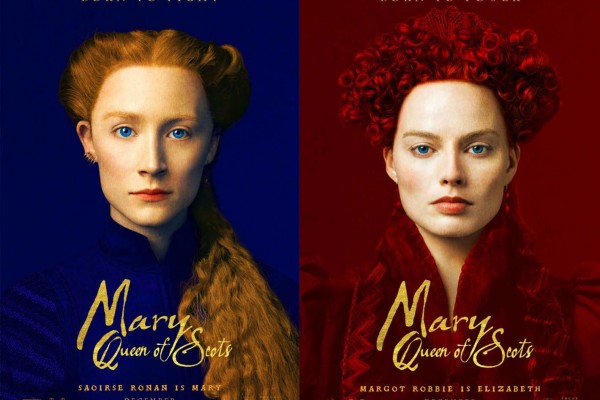
Mary Queen of Scots - a modern re-framing

The machinations of the British royal family eh?  As it was 450 years ago so it is today.  Someone is in favour and someone is on the wane.  Someone thinks someone else should abdicate the throne.  People who don't fit the bill are hounded out by a whispering campaign of the chattering classes.  England and Scotland are uneasy bedfellows.  Some things never change.

In the mid 16th century Elizabeth I sat on the English throne, the only remaining offspring of Henry VIII.  Her distant cousin Mary sat on the Scottish throne, but claimed the throne of England too through her heritage to Henry VII.  That was only a problem because Mary was a catholic and that was very important for some reason.  What the courtiers of England really wanted was Elizabeth to birth an heir so they could put their eggs in this future basket and cast both women aside.  But Elizabeth was having none of it, had no children and refused to name an heir.  Eventually Mary gave birth to a boy who would unite the kingdoms as King James I of England / VI of Scotland, and then she was killed for the privilege.  Spoiler alert.

When a creative force decides to retell a story that has been told a dozen times before in a dozen different ways, one expects there to be a reason for doing so.  In this retelling of the intertwined lives of Mary and Elizabeth, the intention is to rebrand it as a struggle of women against the glass ceiling and male domination.  Here - at its most basic level - Elizabeth succeeds because she shuns her own femininity and rules as a man; whereas Mary fails because she wants to rule as a woman, rather than in spite of it.  Elizabeth refuses to make herself obsolete, as she would be in the eyes of her courtiers were she to create / name an heir.  As soon as Mary has her son and heir, she is doomed - the men around her lose interest in pretending they're loyal to her, discarding her in favour of the male heir.  The choice is clear; act like woman and be condemned for it, or act like a man and be commended for that too.  This is an interesting slant for a contemporary audience familiar with such themes and how they play out in the modern work environment, where there are often vastly different behavioural expectations for men and women.

It is a shame then that the actual film feels incredibly flat.  There are a number of directorial misteps that are scene-breaking.  The worst being at the concluding meeting between the two queens.  The space where they meet is draped with silk demi-curtains that cramp the space and get in the way of several shots.  We spend a very long time with Mary, but far less with Elizabeth, an editing decision that gives Elizabeth much less sympathy than her distant cousin.  It isn't clear if that was intended.  If so then it's odd as this is meant to be about two woman each fighting in their own way to survive in a male-dominated world.  Equal sympathy is deserved surely?  The narrative occasionally jumps periods of time without it being completely clear why other than to maintain historical accuracy.  Finally, there is a short battle sequence in act 2 that is mostly incomprehensible.  What with all participants dressed in similar leather jerkins and slugging it out on a river bank it's messy to the point where I just wanted it to end so we could get on with the story.

Saoirse Ronan and Margot Robbie are great actresses.  Ronan will be rewarded by the Academy eventually, but it was the film's make up and design that was fairly nominated at the 2019 Oscars.  This isn't the only way it was edged out at those awards, since The Favourite was given awards for Olivier Coleman and nominated in multiple technical categories.  That it went head-to-head with The Favourite is prescient and unfortunate, because it meant that not only was Mary Queen of Scots not the best period British monarchy film at the Oscars that year, it was also not the best period British monarchy film that specifically re-examined historical events through the lens of 21st century gender politicsThe Favourite is more engaging scene-to-scene, is superbly-directed & lit, contains beautiful production design and costars Rachel Weisz - an actress too-often under-appreciated by the Academy who was righted nominated for her performance.  I may not have been as blown away by The Favourite as I was hoping, but its treatment of this subject is a level above Mary Queen of Scots.  Save for Ronan and Robbie themselves, I can't find many reasons to recommend this film.  Watch The Favourite.

Wednesday, 22 January 2020

Midsommar - Fairytale meets Nightmare meets MeToo

In one sense Midsommar is a subtle & labyrinthine film, in another sense though it really isn't.

Dani (Florence Pugh) is a young woman who suffers a tragedy when her sister vanishes, committing suicide and killing their parents at the same time.  She decides to go with her unloving boyfriend and his douchebag mates on a Eurotrip to rural Sweden, where one of the guys hopes to encounter a traditional people he is studying for his masters thesis.  Their friend Pelle is Swedish and has agreed to take them to the traditional Midsommar festival, which will celebrate life or some such.  Sounds like a great time.  But of course this is an Ari Astor film, so insanity, deception and a bonkers final act are only 90 minutes of film away - you have been warned.

Initially the film's descent towards a magical nightmare in its final act appears at odds with the very real drug-induced crazy of the previous 2 hours, but the visuals place us clearly in the space of a fairy tale.  Nothing is really real here.  There are a lot of messages lurking in the fairy tale, but somewhere between castigating know-it-all Americans for imposing their world view on the planet and creating a physical manifestation of one woman's loss, the real moral is about the tyranny of self-centred men.  All the men who come with Dani to Sweden are self-obsessed man-children caring either about sex or careers, pursuing self-immolation in the name of a higher power or simply being unable to notice any worldview or culture out side their own.  They are multiple manifestations of the most negative traits present in a certain type of young, privileged man.  With Midsommar, Ari Astor is calling them out; he has made the first fairytale / horror of the MeToo movement.

So far so fine.  Midsommar may be a film that has its moral compass switched on, but does it succeed beyond that?  It's certainly too long, with one or too many tripping out sequences that could have been cut without consequence.  I find it hard to get beyond thinking that it's trying too hard to be too mystical.  The film opens with a mural shot that I presumed probably tells the story to come (it does - I went back and checked), but of course we don't see it long enough to really internalise.  Early shots of Dani and company often show paintings of animals or bleak natural landscapes hung conveniently above their heads - foreshadowing their eventual fate.  Though these elements serve to underscore that this is a fairy tale (i.e. Ari Astor doesn't really think we should kill off annoying privileged young American men!), it's a touch heavy-handed.  It's these elements that make the film feel a lot more complex than it really is.  For all that messaging and psychedellic shifts of tone and shock moments, it actually has quite a straight message.  Guys - it isn't all about you.

Saturday, 11 January 2020

Bad Boys 2 - My apologies to the world

It would be going too far to say that I enjoyed watching Bad Boys last week, but suffice to say that I now understand the guilty pleasure of that who do.  Paper thin plot, casual misogyny, guns-all-balzing buddy cop movies have been a staple of a certain cinematic genre for decades.  Bad Boys brought the charismatic Will Smith and Martin Lawrence to the genre, and 'livened' everything up through Michael Bay's insane directorial style.  It was the cinematic equivalent of the sidebar on the Daily Mail website - we might not like it, but there's a reason it gets so many clicks.

Just what was it that Bay / Bruckheimer thought it was about Bad Boys that made it a success and that they needed to replicate in the sequel?  The original was silly and littered with light-touch misogyny, but was silly fun and had nothing of the overt crassness and desperation of part 2.  Never was a film more in need of an editor - or even someone ready to point out that some things simply aren't funny.  An animatronic pair of rats having sex - not funny.  A scene where dead bodies tumble out of a coroner's van and get run over - not funny.  Martin Lawrence accidentally takes Ecstasy - funny for 1 minute, not funny after 5!

In a normal review I might apologise for having skipped on too far at this point.  How about a quick overview of the plot?  What even is Bad Boys 2?  Well this isn't a normal review.  Bad Boys 2 only has a plot in the same way that Russian dashcam footage on youtube has a 'plot' - you're just waiting for the next crash.  Imagine everything that's wrong with society, every prurient politician who turns out to be a sex pest, every preacher who is revealed as a kiddy-fiddler, every union official on the take from organised crime, every Daily Express article lambasting the crass sexualisation of youth that shares the same front page as a photo expose of the newest youngest 16 year old starlet, every article in The Sun demonising immigrants and at the same time asking why football fans are racists.  All of that.  Imagine all of that distilled into 150 minutes of film.  That is Bad Boys 2.  It's encapsulated by a long montage near the start - probably intended to show us that drugs are bad (the bad guy is a drug king pin).  The montage takes us through a neon & florescent lit night club.  The guys and the girls are drinking, popping pills and having a great time.  The camera tracks and pans around dozens of party-goers, up-skirting all the girls and moving with the beat.  The montage then ends on one guy who appears to be over-dosing, and is thrown out on to the streets.  This is Daily Mail moralising; happy to titillate its readers with the saucy details and take their money for the privilege, but then ending on a moral downturn, expecting everyone to believe that the message is "drugs are bad" and claiming to not understand when some of its readers took them seriously.  With this one montage Michael Bay did more than some of his contemporaries will do in their entire careers to capture the hypocritical pseudo-morality of our age.  If only it was done with any satire.  Sadly Bay is playing it entirely for the titillation.  Bollocks to him, and bollocks to his film.

At 2 hours and 30 minutes, even the glimmers of hope (and they do exist) are overshadowed by the running time and the relentless drive to turn the dial on every action scene up to 11.  The film ends with what should be a breathtaking pinnacle, as Smith and Lawrence are chased in Humvees through a Cuban shanty town.  It looks like the production crew built a shanty town on a hillside and drive a load of cars through it, set off a bunch of explosions and trashed the whole thing.  This probably cost an enourmous amount of money, time and manpower to produce.  But rather than allow the stunts space to breathe on screen, we are treated to a series of jarring cuts that make this indistinguishable from the half dozen other cgi & effects-driven chases earlier in the movie.  Even when the film has the potential to be good, Bay doesn't seem to realise it and just fucks it up.

The one upside?  I now understand more of the references in Hot Fuzz.

Tuesday, 7 January 2020

Bad Boys - Opening scene analysis

The film watching year got off to an interesting start recently.  In the last few months since I posted on here I have watched several 'good' films, but I am drawn towards a bit of film analysis after watching Bad Boys.  All films are worth watching, even this 1995 action comedy that Michael Bay used to introduced the world to his unique paparazzi style of film making.  Everything is dialled up as high as possible, everything is as crass as possible.  Everything is Bay:


The opening precredits scene of Bad Boys provides a wealth of detail about Bay's style and tells us much about the film to come.  We open with heavily-filtered shots of a steaming hot afternoon on the Miami coast, the camera flies over the clouds and sea before switching between close up and telephoto shots of a speeding sports car.  Electronic music pounds and begins to rise.

Quickly we are inside the car listening to the Tarantino-like dialogue of two characters talking shit.  Except these guys aren't chatting about what the French call a Big Mac, they're telling us two things 1) they sleep with beautiful woman, 2) this is a very expensive car (exact price tag provided).  They pull over.  A pretty woman with no lines is introduced with an upskirt shot and used as a distraction.  Pounding music continues to rise in volume.  Our two wise-cracking leads overcome being car-jacked by cracking wisely.  Cut to credits.

As far as film openings go, absolutely everything you need to know about Bad Boys is clear from this scene.  This will be a film about two wise cracking bad-asses who will beat the bad guys by cracking wiser and smarter than anyone around them.  They value money, sex, beautiful women and chatting shit.  Female characters will be defined by their clothes and attractiveness to men.  The audience will be distracted from any flaws in the movie by 1) girls 2) sass 3) cars and 4) all of the above.

Every Frame a Painting produced an excellent dissection of Bay's style several years ago, and everything he talks about is present in Bad Boys.  Bays style is reflective of a style that's immediate, over-produced and stylish at the expense of any substance.  His work has influenced and come to be influenced by commodification of our times, of people defining themselves by their relationships with money & wealth, and of the desire to get the most 'likes' - where in the crowded online space only the most extreme gets any airtime.  If ever there was a film-maker who's work defines our era - for good or ill one can make a strong case for Michael Bay.

Better films to be reviewed later I promise!

Friday, 20 September 2019

Fiddler on the Roof - Sunrise Sunset

Just finished watching Fiddler on the Roof.  Wonderful storytelling.  Felt the need to share the film's centrepiece song Sunrise Sunset.  Sung during the wedding of Tzeitel and Motel, the sung is sweet, moving and beautifully performed here with an Oscar-winning arrangement.  Tear-jerking for all the right reasons.


Wednesday, 11 September 2019

The Favourite - not quite my favourite

Earlier this year Olivia Coleman won an Oscar for her performance as Queen Anne in The Favourite.  She has been a stalwart of British TV and transatlantic film for years, and rightfully was honoured for the work she has been involved in.  It feels like there is a limit number of female actors who are allowed to be big stars as they age, Coleman is only 45, but the industry appears to be grooming her as the next Judi Dench.  Why else would she be cast as two versions of the British monarch in two years (she has since been cast as our very own Liz in the 4th series of The Crown)?  Watching The Favourite reveals why she was the Academy's choice this year, her character swings from the regal to the mad, from isolation to outrageous expressiveness, and crucially goes through a decent into weakness and madness that bares her inner self.  It's a classic Oscar-bait role.

The Favourite puts a 17th century spin on both the class and gender differences that lie at the heart of Western society.  Starring alongside Coleman is an actress who matches her step for step - Rachel Weisz is outstanding as Anne's confidant, secret lover and #1 adviser Sarah Churchill.  It's a story about how throughout history there have been women as powerful, driven and Machiavellian as any men in the modern era, and men as vain and love-stricken as any doting 1950s wife was expected to be.  The plot focuses on intrigue at court as Queen Anne's health fails and war in France comes to its final stages.  Churchill attempts to run the country and military over the lesser-qualified heads of the simpering men of parliament.  Into this lands Churchill's cousin Abigail Marsham (Emma Stone) - vying to regain influence in the only way a woman in the 17th century could rely, through the favour of a man (or perhaps woman) of power and wealth.

Filmed on site at Hatfield house in Hertfordshire, the production team have gone to extraordinary lengths to capture the location on screen.  The cinematography makes liberal use of a fish eye lens, often sitting in one locations and pivoting around to follow movement - bringing to the attention of the viewer the fact this is very much not a set.  Extensive use of candle light necessitates expert lighting to keep everything as dark as possible while picking out facial detail - perfectly executed here.  The film rightly won Oscars for both production design and costume.  Black and white costumes feature strongly amongst its female protagonists, emphasising their role as central power-brokers as opposed to simpering extras.

All this praise, and yet The Favourite didn't completely grip me.  Perhaps it was the niggling feeling that the use of the fish eye lens was mostly to show off Hatfield House rather than an artistic decision?  Perhaps 'intrigue at court' plot lines featuring British monarchs have become so commonplace that they bore me?  Perhaps there's a subconscious part of my brain getting discombobulated by the lack of patriarchy (all those simpering make-up-wearing idiots chasing adoringly after partially-interested women - is this what it is like to watch most films as a woman?).  Whatever it is, I'm sure it will recede upon a second viewing - there are simply too many good things to say about this film.  The Favourite is obviously a film I will recommend.