One of the very few benefits of lock-down time (I write this in May 2020 - UK) is having the time to watch all the films you never watched. I never thought I'd ever say this, but thank all that's holy for Amazon Prime.
On my girlfriend's big list of films she hasn't seen, there are several quite ridiculous entries, of which the biggest was possibly Jurassic Park. Just how someone can be a kid in the 1990s and not manage to see Jurassic Park is a serious mystery. The fact that as I write this Jurassic Park is available for free on Amazon Prime is something to just be thankful for.
Just in case you've been living under a stone for your whole life - a plot summary: John Hammond (Richard Attenborough) is an unthinkably rich former flea circus operator who has harnessed the power of science to create actual, real-life dinosaurs. He has created a theme park to house the dinosaurs and wants a seal of approval from some actual palaeontologists - enter Sam Neil and Laura Dern. What follows is part theme park ride, part horror, part story of the hubris of man - but mostly a tale about family. It is one of the most famous, and high-earning films of all time. The film's logo is iconic. There have been any number of sequel and spin-offs. The film's place in cinema history is certain.
The success of Jurassic Park lies mainly in the special effects that even 27 years on still just holds up. Actual dinosaurs. But the success also lies in the way the film sits exactly on the line between not enough and too much. Just enough to scare the kids, not too much to get a 15 certificate. Just enough about family to tug at heart strings, but never straying into cheese. Its final hour is relentlessly paced, but with a set-up so well-crafted that each mini crisis flows perfectly into the next without being at all repetitive. The film's effects are the film's primary draw, but it is instructive to reflect on its structure, and how well Spielberg sticks to the maxim of show-don't-tell. Witness the scene introducing Sean Neil's character, in a series of simple interactions we learn Alan Grant 1) is a palaeontologist 2) doesn't like kids and 3) likes partner-in-dinosaurs Ellie. We also learn that a T-Rex sees with motion and that Velociraptors hunt in packs and the ones you don't see are the ones that get you. All simple, natural, character-building dialogue. It's done again when mathematician Jeff Goldblum explains Chaos Theory to the audience through the medium of flirting with Ellie. And then again when Hammond tells everyone his backstory. By the time the film ramps up into chase mode at some point in the middle of the second act we are armed with all the knowledge needed to understand every movement and beat of what's to come. This is how you make films. Spielberg really is a master.
So regardless of if you've seen it before (I will assume you have) or not - Jurassic Park is still great.
Monday, 4 May 2020
Tuesday, 28 April 2020
Green Book - great actors, moralising-by-numbers
How simplistic do you like your race relations? Well if you like it predictable, Green Book is your film. Green Book tells the semi-real story of how semi-racist Tony Lip (Viggo Mortensen) takes a job driving Don Shirley (Mahershala Ali) around the Southern US states, partly cos he needed a driver, but mostly because he needed someone hard-as-nails who could get him out of the almost inevitable strife that being a black man in Alabama in the 1960s would generate. Tony needs to be home for Xmas. Don needs to play his final gig in Birmingham Alabama on December 23rd. Go ahead and try to write the script. How do you think it'll end? Seriously have a go - you'll probably get it right.
Which is one of a number of reasons why Green Book doesn't quite work as well as I imagine the production team would have hoped. Aside from the linearity and predictability of the plot, the film hits every beat you would expect it to. Tony Lip is a racist, he interacts with a bunch of black people and learns not to be. Shirley feels like an outcast, he experiences the simple pleasures of 1960s Americana and learns not to be. Nothing wrong with this, but for a film that was billed for its relevance in an age of Black Lives Matter, it's not really good enough. Additionally, Tony Lip is a little too racist at the start of the film. I wasn't around in the 1960s, but this film was made in 2018 and it is something of a stretch to believe a man who would throw away glasses black workmen drank out of will a few months later invite a black man into his house for Xmas. Or was casual I'm-not-racist-but racism in the 1960s really like that? Am I really that naive?
Green Book won a series of awards at the Oscars, and one of course wonders how much of this was influenced by the now annual accusation that the ceremony is 'so white'. What better way to demonstrate inclusivity than dish out the awards to the film that does 'race' relations, the film in which the misguided-but-lovable white guy from New York realises not to be a racist? Don't get me wrong, Mahershala Ali deserved the award, but best film Green Book isn't. BlacKkKlansman is a better film and speaks in a much deeper way about the black experience in the USA; at least it got the best screenplay award.
In watching the film I was reminded of the Simpsons episode where Homer struggles to cope with new guy in town - John - who is gay. The episode ends with Homer finally accepting John for who he is after John saves Homer's life. John quips "I won your respect; and all I had to do was save your life. Now if only every gay man could do that - you'd be set.". Homer reacts: "Amen to that". In two lines The Simpsons in 1997 was far more cutting in critiquing society's demand that people justify themselves for their differences than this film is over a full 2 hours.
All of this is not to say that Green Book isn't a good watch. Ali and Mortensen are great actors, and it's worth one's time to see them riff off each other for an hour. Just don't expect to feel all warm and fuzzy about the US at the end of it.
Which is one of a number of reasons why Green Book doesn't quite work as well as I imagine the production team would have hoped. Aside from the linearity and predictability of the plot, the film hits every beat you would expect it to. Tony Lip is a racist, he interacts with a bunch of black people and learns not to be. Shirley feels like an outcast, he experiences the simple pleasures of 1960s Americana and learns not to be. Nothing wrong with this, but for a film that was billed for its relevance in an age of Black Lives Matter, it's not really good enough. Additionally, Tony Lip is a little too racist at the start of the film. I wasn't around in the 1960s, but this film was made in 2018 and it is something of a stretch to believe a man who would throw away glasses black workmen drank out of will a few months later invite a black man into his house for Xmas. Or was casual I'm-not-racist-but racism in the 1960s really like that? Am I really that naive?
Green Book won a series of awards at the Oscars, and one of course wonders how much of this was influenced by the now annual accusation that the ceremony is 'so white'. What better way to demonstrate inclusivity than dish out the awards to the film that does 'race' relations, the film in which the misguided-but-lovable white guy from New York realises not to be a racist? Don't get me wrong, Mahershala Ali deserved the award, but best film Green Book isn't. BlacKkKlansman is a better film and speaks in a much deeper way about the black experience in the USA; at least it got the best screenplay award.
In watching the film I was reminded of the Simpsons episode where Homer struggles to cope with new guy in town - John - who is gay. The episode ends with Homer finally accepting John for who he is after John saves Homer's life. John quips "I won your respect; and all I had to do was save your life. Now if only every gay man could do that - you'd be set.". Homer reacts: "Amen to that". In two lines The Simpsons in 1997 was far more cutting in critiquing society's demand that people justify themselves for their differences than this film is over a full 2 hours.
All of this is not to say that Green Book isn't a good watch. Ali and Mortensen are great actors, and it's worth one's time to see them riff off each other for an hour. Just don't expect to feel all warm and fuzzy about the US at the end of it.
Monday, 27 April 2020
The Searchers - Westerns not my thing I guess
Writing this in April 2020 - the age of lock-down - it seems completely natural that I would get back to my film-watching roots and watch all of the films. Got enough time for it whatever else is happening in the world. Hunting around for film genres I'm not even slightly abreast of usually involves getting very obscure these days, however there is one major genre I never really got into. Or understood. Or watched.
The Western is a genre that seems to have arisen out of a very specific set of circumstances surrounding the creation of the nation state that is the USA. The pioneers that created that nation are lauded; be they religious extremists from Western Europe settling on the Eastern seaboard or astronauts setting foot on the moon, in amongst them are the intrepid explorers who set off over the Appalachian mountains to colonise a land already occupied by more people than some versions of history want us to remember. They took weapons with them into a hostile land, and so the USA's 2nd amendment was born. They colonised a land of considerable mineral wealth and gave the modern USA a backyard of endless resources with which to build a superpower. And hence the Western was born of a lionisation of those individuals. Their crimes against native peoples were brushed over. The hardships endured were recast as a forging of a nation.
Hence The Searchers. If you hunt around for not very long at all on the internet you'll be told by more than one source that The Searcher is one of the greatest Westerns ever made - if not the greatest.
Hmmm...
Watching The Searchers is an odd experience. Like any art created in a different era, it is always important to understand its contemporary impact. From a modern standpoint The Searchers is racist, and The Searchers is sexist. It is hard to understand how that could have been different in a 1950s setting. America was a very different place, but it is hard to understand how anyone could see any good in the character portrayed by John Wayne - Ethan Edwards. Edwards is a veteran of war and returns to his family shortly before local Comanches attack their residence and kill his brother's family, kidnapping his niece. Edwards then spends the next several years hunting down the kidnappers, more out of rage and revenge than any real desire to save her. In fact Edwards even resolves to kill her if she has gone 'too far' and turned Comanche. Better to be dead than a Comanche. Is this what happens in Westerns?
And so it is that we follow Edwards and several companions trailing the Comanche. Occasionally they chance upon a bar and ask questions, one time they arrive back at the ranch and Edwards' companion tries to reignite a romance, at the end they turn up at her wedding and start a fight for some reason to prove some point of idiotic masculinity. If the film is a critique of Westerns, it isn't strong enough. If the film is celebrating individuals like Edwards, then it's zigzagging tone makes it feel extremely unsure of itself. The female characters do nothing except wait for the men folk to turn up and save / marry them. The Comanche characters do nothing except growl and shoot guns. The male characters do nothing but look bedraggled and gaze hopelessly towards the horizon. The film is at best a loose critique of a world thankfully behind us, and at worst it is a shameful document reminding us that world isn't as far behind us as we'd wish. Or maybe Westerns just aren't for me. Probably wont be watching any more John Wayne films - not unless the lock-down goes on for a loooong time...
The Western is a genre that seems to have arisen out of a very specific set of circumstances surrounding the creation of the nation state that is the USA. The pioneers that created that nation are lauded; be they religious extremists from Western Europe settling on the Eastern seaboard or astronauts setting foot on the moon, in amongst them are the intrepid explorers who set off over the Appalachian mountains to colonise a land already occupied by more people than some versions of history want us to remember. They took weapons with them into a hostile land, and so the USA's 2nd amendment was born. They colonised a land of considerable mineral wealth and gave the modern USA a backyard of endless resources with which to build a superpower. And hence the Western was born of a lionisation of those individuals. Their crimes against native peoples were brushed over. The hardships endured were recast as a forging of a nation.
Hence The Searchers. If you hunt around for not very long at all on the internet you'll be told by more than one source that The Searcher is one of the greatest Westerns ever made - if not the greatest.
Hmmm...
Watching The Searchers is an odd experience. Like any art created in a different era, it is always important to understand its contemporary impact. From a modern standpoint The Searchers is racist, and The Searchers is sexist. It is hard to understand how that could have been different in a 1950s setting. America was a very different place, but it is hard to understand how anyone could see any good in the character portrayed by John Wayne - Ethan Edwards. Edwards is a veteran of war and returns to his family shortly before local Comanches attack their residence and kill his brother's family, kidnapping his niece. Edwards then spends the next several years hunting down the kidnappers, more out of rage and revenge than any real desire to save her. In fact Edwards even resolves to kill her if she has gone 'too far' and turned Comanche. Better to be dead than a Comanche. Is this what happens in Westerns?
And so it is that we follow Edwards and several companions trailing the Comanche. Occasionally they chance upon a bar and ask questions, one time they arrive back at the ranch and Edwards' companion tries to reignite a romance, at the end they turn up at her wedding and start a fight for some reason to prove some point of idiotic masculinity. If the film is a critique of Westerns, it isn't strong enough. If the film is celebrating individuals like Edwards, then it's zigzagging tone makes it feel extremely unsure of itself. The female characters do nothing except wait for the men folk to turn up and save / marry them. The Comanche characters do nothing except growl and shoot guns. The male characters do nothing but look bedraggled and gaze hopelessly towards the horizon. The film is at best a loose critique of a world thankfully behind us, and at worst it is a shameful document reminding us that world isn't as far behind us as we'd wish. Or maybe Westerns just aren't for me. Probably wont be watching any more John Wayne films - not unless the lock-down goes on for a loooong time...
Thursday, 12 March 2020
Parasite - A masterwork
I went into Aldershot Cineworld 4 weeks ago with some trepidation. With the cinematic world in an absolute gush over Parasite, what if I didn't like it? The awkward conversations with friends of mine would be just the tip of the iceberg. Imagine having to go through your life defending a position against overwhelming consensus - the absolute hard work of it. Just so much hard work.
Parasite - luckily - is a masterwork. Rarely upon watching a film is it so clear so quickly that such a description isn't an overstatement. Rarely does it become even more apparent the more one thinks about what one has seen. Parasite is the first non-English language film to win best picture at the Oscars. It is that rarest of rare things - the Academy getting it right.
At its simplest level Parasite is a deconstruction of the madness of our capitalist system. Through smart characterisation and story-telling, it rips apart the contradictions of class in that system by setting two families against each other. The Kims are poor. The Parks are wealthy. By the end of the first act the Kims have inveigled themselves into the Parks' lives by posing as various hired help. Mother Kim the housekeeper, father Kim the chauffeur, son Kim the teacher, daughter Kim the therapist. Are these lies created to prey on the upper-middle class fears of the Park family and quietly pocket their cash? Or perhaps they're the actions of smart entrepreneurial underdogs doing nothing less than spotting a market for society's latest panacea? Or neither? Or both? Capitalism much?
This story is rich enough in itself to merit your attention. However it is myriad of other details that turn this film into the masterwork it has already been lauded. Smart use of camerawork and set / setting convey visually the difference between the Kims and Parks. A character ascends and is blinded by the sun as he emerges into the golden pastures of the Parks' garden. The Kim family manifest as cockroaches under the Parks' furniture. The families' respective houses each have a window looking out on to a jarringly different view of the world. These and many, many others demonstrate an attention to detail in the creation of this film that elevates it far beyond its basic story. The apex of the first act is as flawless a sequence of cinematic storytelling as I have ever seen. The more I think about it, the more analysis I absorb of its visual breadth, the more I am in awe.
The film naturally asks us to consider the meaning of its title. Who or what is the parasite? The Kims naturally prey on the Parks, but then the Parks treat their help with inhuman disdain. Then there is the underclass, leaching from everyone else. The final message either condemns everyone or gives them all a pass as mere pawns in capitalism's great never-ending game. In years to come A-Level film studies students will write essays on this exact question - and it feels an honour to have been there when it first came out. Parasite is a masterpiece.
Parasite - luckily - is a masterwork. Rarely upon watching a film is it so clear so quickly that such a description isn't an overstatement. Rarely does it become even more apparent the more one thinks about what one has seen. Parasite is the first non-English language film to win best picture at the Oscars. It is that rarest of rare things - the Academy getting it right.
At its simplest level Parasite is a deconstruction of the madness of our capitalist system. Through smart characterisation and story-telling, it rips apart the contradictions of class in that system by setting two families against each other. The Kims are poor. The Parks are wealthy. By the end of the first act the Kims have inveigled themselves into the Parks' lives by posing as various hired help. Mother Kim the housekeeper, father Kim the chauffeur, son Kim the teacher, daughter Kim the therapist. Are these lies created to prey on the upper-middle class fears of the Park family and quietly pocket their cash? Or perhaps they're the actions of smart entrepreneurial underdogs doing nothing less than spotting a market for society's latest panacea? Or neither? Or both? Capitalism much?
This story is rich enough in itself to merit your attention. However it is myriad of other details that turn this film into the masterwork it has already been lauded. Smart use of camerawork and set / setting convey visually the difference between the Kims and Parks. A character ascends and is blinded by the sun as he emerges into the golden pastures of the Parks' garden. The Kim family manifest as cockroaches under the Parks' furniture. The families' respective houses each have a window looking out on to a jarringly different view of the world. These and many, many others demonstrate an attention to detail in the creation of this film that elevates it far beyond its basic story. The apex of the first act is as flawless a sequence of cinematic storytelling as I have ever seen. The more I think about it, the more analysis I absorb of its visual breadth, the more I am in awe.
The film naturally asks us to consider the meaning of its title. Who or what is the parasite? The Kims naturally prey on the Parks, but then the Parks treat their help with inhuman disdain. Then there is the underclass, leaching from everyone else. The final message either condemns everyone or gives them all a pass as mere pawns in capitalism's great never-ending game. In years to come A-Level film studies students will write essays on this exact question - and it feels an honour to have been there when it first came out. Parasite is a masterpiece.
Tuesday, 11 February 2020
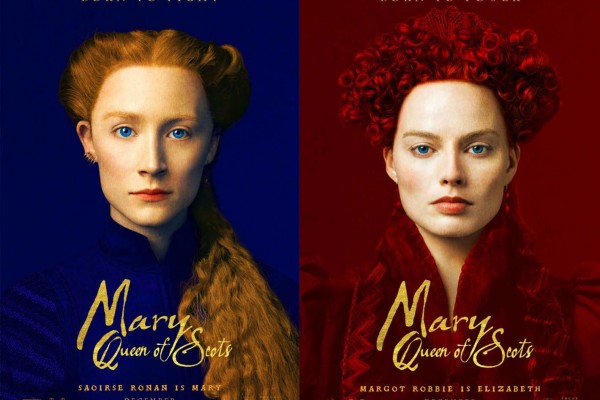
Mary Queen of Scots - a modern re-framing
The machinations of the British royal family eh? As it was 450 years ago so it is today. Someone is in favour and someone is on the wane. Someone thinks someone else should abdicate the throne. People who don't fit the bill are hounded out by a whispering campaign of the chattering classes. England and Scotland are uneasy bedfellows. Some things never change.
In the mid 16th century Elizabeth I sat on the English throne, the only remaining offspring of Henry VIII. Her distant cousin Mary sat on the Scottish throne, but claimed the throne of England too through her heritage to Henry VII. That was only a problem because Mary was a catholic and that was very important for some reason. What the courtiers of England really wanted was Elizabeth to birth an heir so they could put their eggs in this future basket and cast both women aside. But Elizabeth was having none of it, had no children and refused to name an heir. Eventually Mary gave birth to a boy who would unite the kingdoms as King James I of England / VI of Scotland, and then she was killed for the privilege. Spoiler alert.
When a creative force decides to retell a story that has been told a dozen times before in a dozen different ways, one expects there to be a reason for doing so. In this retelling of the intertwined lives of Mary and Elizabeth, the intention is to rebrand it as a struggle of women against the glass ceiling and male domination. Here - at its most basic level - Elizabeth succeeds because she shuns her own femininity and rules as a man; whereas Mary fails because she wants to rule as a woman, rather than in spite of it. Elizabeth refuses to make herself obsolete, as she would be in the eyes of her courtiers were she to create / name an heir. As soon as Mary has her son and heir, she is doomed - the men around her lose interest in pretending they're loyal to her, discarding her in favour of the male heir. The choice is clear; act like woman and be condemned for it, or act like a man and be commended for that too. This is an interesting slant for a contemporary audience familiar with such themes and how they play out in the modern work environment, where there are often vastly different behavioural expectations for men and women.
It is a shame then that the actual film feels incredibly flat. There are a number of directorial misteps that are scene-breaking. The worst being at the concluding meeting between the two queens. The space where they meet is draped with silk demi-curtains that cramp the space and get in the way of several shots. We spend a very long time with Mary, but far less with Elizabeth, an editing decision that gives Elizabeth much less sympathy than her distant cousin. It isn't clear if that was intended. If so then it's odd as this is meant to be about two woman each fighting in their own way to survive in a male-dominated world. Equal sympathy is deserved surely? The narrative occasionally jumps periods of time without it being completely clear why other than to maintain historical accuracy. Finally, there is a short battle sequence in act 2 that is mostly incomprehensible. What with all participants dressed in similar leather jerkins and slugging it out on a river bank it's messy to the point where I just wanted it to end so we could get on with the story.
Saoirse Ronan and Margot Robbie are great actresses. Ronan will be rewarded by the Academy eventually, but it was the film's make up and design that was fairly nominated at the 2019 Oscars. This isn't the only way it was edged out at those awards, since The Favourite was given awards for Olivier Coleman and nominated in multiple technical categories. That it went head-to-head with The Favourite is prescient and unfortunate, because it meant that not only was Mary Queen of Scots not the best period British monarchy film at the Oscars that year, it was also not the best period British monarchy film that specifically re-examined historical events through the lens of 21st century gender politics. The Favourite is more engaging scene-to-scene, is superbly-directed & lit, contains beautiful production design and costars Rachel Weisz - an actress too-often under-appreciated by the Academy who was righted nominated for her performance. I may not have been as blown away by The Favourite as I was hoping, but its treatment of this subject is a level above Mary Queen of Scots. Save for Ronan and Robbie themselves, I can't find many reasons to recommend this film. Watch The Favourite.
In the mid 16th century Elizabeth I sat on the English throne, the only remaining offspring of Henry VIII. Her distant cousin Mary sat on the Scottish throne, but claimed the throne of England too through her heritage to Henry VII. That was only a problem because Mary was a catholic and that was very important for some reason. What the courtiers of England really wanted was Elizabeth to birth an heir so they could put their eggs in this future basket and cast both women aside. But Elizabeth was having none of it, had no children and refused to name an heir. Eventually Mary gave birth to a boy who would unite the kingdoms as King James I of England / VI of Scotland, and then she was killed for the privilege. Spoiler alert.
When a creative force decides to retell a story that has been told a dozen times before in a dozen different ways, one expects there to be a reason for doing so. In this retelling of the intertwined lives of Mary and Elizabeth, the intention is to rebrand it as a struggle of women against the glass ceiling and male domination. Here - at its most basic level - Elizabeth succeeds because she shuns her own femininity and rules as a man; whereas Mary fails because she wants to rule as a woman, rather than in spite of it. Elizabeth refuses to make herself obsolete, as she would be in the eyes of her courtiers were she to create / name an heir. As soon as Mary has her son and heir, she is doomed - the men around her lose interest in pretending they're loyal to her, discarding her in favour of the male heir. The choice is clear; act like woman and be condemned for it, or act like a man and be commended for that too. This is an interesting slant for a contemporary audience familiar with such themes and how they play out in the modern work environment, where there are often vastly different behavioural expectations for men and women.
It is a shame then that the actual film feels incredibly flat. There are a number of directorial misteps that are scene-breaking. The worst being at the concluding meeting between the two queens. The space where they meet is draped with silk demi-curtains that cramp the space and get in the way of several shots. We spend a very long time with Mary, but far less with Elizabeth, an editing decision that gives Elizabeth much less sympathy than her distant cousin. It isn't clear if that was intended. If so then it's odd as this is meant to be about two woman each fighting in their own way to survive in a male-dominated world. Equal sympathy is deserved surely? The narrative occasionally jumps periods of time without it being completely clear why other than to maintain historical accuracy. Finally, there is a short battle sequence in act 2 that is mostly incomprehensible. What with all participants dressed in similar leather jerkins and slugging it out on a river bank it's messy to the point where I just wanted it to end so we could get on with the story.
Saoirse Ronan and Margot Robbie are great actresses. Ronan will be rewarded by the Academy eventually, but it was the film's make up and design that was fairly nominated at the 2019 Oscars. This isn't the only way it was edged out at those awards, since The Favourite was given awards for Olivier Coleman and nominated in multiple technical categories. That it went head-to-head with The Favourite is prescient and unfortunate, because it meant that not only was Mary Queen of Scots not the best period British monarchy film at the Oscars that year, it was also not the best period British monarchy film that specifically re-examined historical events through the lens of 21st century gender politics. The Favourite is more engaging scene-to-scene, is superbly-directed & lit, contains beautiful production design and costars Rachel Weisz - an actress too-often under-appreciated by the Academy who was righted nominated for her performance. I may not have been as blown away by The Favourite as I was hoping, but its treatment of this subject is a level above Mary Queen of Scots. Save for Ronan and Robbie themselves, I can't find many reasons to recommend this film. Watch The Favourite.
Wednesday, 22 January 2020
Midsommar - Fairytale meets Nightmare meets MeToo
In one sense Midsommar is a subtle & labyrinthine film, in another sense though it really isn't.
Dani (Florence Pugh) is a young woman who suffers a tragedy when her sister vanishes, committing suicide and killing their parents at the same time. She decides to go with her unloving boyfriend and his douchebag mates on a Eurotrip to rural Sweden, where one of the guys hopes to encounter a traditional people he is studying for his masters thesis. Their friend Pelle is Swedish and has agreed to take them to the traditional Midsommar festival, which will celebrate life or some such. Sounds like a great time. But of course this is an Ari Astor film, so insanity, deception and a bonkers final act are only 90 minutes of film away - you have been warned.
Initially the film's descent towards a magical nightmare in its final act appears at odds with the very real drug-induced crazy of the previous 2 hours, but the visuals place us clearly in the space of a fairy tale. Nothing is really real here. There are a lot of messages lurking in the fairy tale, but somewhere between castigating know-it-all Americans for imposing their world view on the planet and creating a physical manifestation of one woman's loss, the real moral is about the tyranny of self-centred men. All the men who come with Dani to Sweden are self-obsessed man-children caring either about sex or careers, pursuing self-immolation in the name of a higher power or simply being unable to notice any worldview or culture out side their own. They are multiple manifestations of the most negative traits present in a certain type of young, privileged man. With Midsommar, Ari Astor is calling them out; he has made the first fairytale / horror of the MeToo movement.
So far so fine. Midsommar may be a film that has its moral compass switched on, but does it succeed beyond that? It's certainly too long, with one or too many tripping out sequences that could have been cut without consequence. I find it hard to get beyond thinking that it's trying too hard to be too mystical. The film opens with a mural shot that I presumed probably tells the story to come (it does - I went back and checked), but of course we don't see it long enough to really internalise. Early shots of Dani and company often show paintings of animals or bleak natural landscapes hung conveniently above their heads - foreshadowing their eventual fate. Though these elements serve to underscore that this is a fairy tale (i.e. Ari Astor doesn't really think we should kill off annoying privileged young American men!), it's a touch heavy-handed. It's these elements that make the film feel a lot more complex than it really is. For all that messaging and psychedellic shifts of tone and shock moments, it actually has quite a straight message. Guys - it isn't all about you.
Dani (Florence Pugh) is a young woman who suffers a tragedy when her sister vanishes, committing suicide and killing their parents at the same time. She decides to go with her unloving boyfriend and his douchebag mates on a Eurotrip to rural Sweden, where one of the guys hopes to encounter a traditional people he is studying for his masters thesis. Their friend Pelle is Swedish and has agreed to take them to the traditional Midsommar festival, which will celebrate life or some such. Sounds like a great time. But of course this is an Ari Astor film, so insanity, deception and a bonkers final act are only 90 minutes of film away - you have been warned.
Initially the film's descent towards a magical nightmare in its final act appears at odds with the very real drug-induced crazy of the previous 2 hours, but the visuals place us clearly in the space of a fairy tale. Nothing is really real here. There are a lot of messages lurking in the fairy tale, but somewhere between castigating know-it-all Americans for imposing their world view on the planet and creating a physical manifestation of one woman's loss, the real moral is about the tyranny of self-centred men. All the men who come with Dani to Sweden are self-obsessed man-children caring either about sex or careers, pursuing self-immolation in the name of a higher power or simply being unable to notice any worldview or culture out side their own. They are multiple manifestations of the most negative traits present in a certain type of young, privileged man. With Midsommar, Ari Astor is calling them out; he has made the first fairytale / horror of the MeToo movement.
So far so fine. Midsommar may be a film that has its moral compass switched on, but does it succeed beyond that? It's certainly too long, with one or too many tripping out sequences that could have been cut without consequence. I find it hard to get beyond thinking that it's trying too hard to be too mystical. The film opens with a mural shot that I presumed probably tells the story to come (it does - I went back and checked), but of course we don't see it long enough to really internalise. Early shots of Dani and company often show paintings of animals or bleak natural landscapes hung conveniently above their heads - foreshadowing their eventual fate. Though these elements serve to underscore that this is a fairy tale (i.e. Ari Astor doesn't really think we should kill off annoying privileged young American men!), it's a touch heavy-handed. It's these elements that make the film feel a lot more complex than it really is. For all that messaging and psychedellic shifts of tone and shock moments, it actually has quite a straight message. Guys - it isn't all about you.
Saturday, 11 January 2020
Bad Boys 2 - My apologies to the world
It would be going too far to say that I enjoyed watching Bad Boys last week, but suffice to say that I now understand the guilty pleasure of that who do. Paper thin plot, casual misogyny, guns-all-balzing buddy cop movies have been a staple of a certain cinematic genre for decades. Bad Boys brought the charismatic Will Smith and Martin Lawrence to the genre, and 'livened' everything up through Michael Bay's insane directorial style. It was the cinematic equivalent of the sidebar on the Daily Mail website - we might not like it, but there's a reason it gets so many clicks.
Just what was it that Bay / Bruckheimer thought it was about Bad Boys that made it a success and that they needed to replicate in the sequel? The original was silly and littered with light-touch misogyny, but was silly fun and had nothing of the overt crassness and desperation of part 2. Never was a film more in need of an editor - or even someone ready to point out that some things simply aren't funny. An animatronic pair of rats having sex - not funny. A scene where dead bodies tumble out of a coroner's van and get run over - not funny. Martin Lawrence accidentally takes Ecstasy - funny for 1 minute, not funny after 5!
In a normal review I might apologise for having skipped on too far at this point. How about a quick overview of the plot? What even is Bad Boys 2? Well this isn't a normal review. Bad Boys 2 only has a plot in the same way that Russian dashcam footage on youtube has a 'plot' - you're just waiting for the next crash. Imagine everything that's wrong with society, every prurient politician who turns out to be a sex pest, every preacher who is revealed as a kiddy-fiddler, every union official on the take from organised crime, every Daily Express article lambasting the crass sexualisation of youth that shares the same front page as a photo expose of the newest youngest 16 year old starlet, every article in The Sun demonising immigrants and at the same time asking why football fans are racists. All of that. Imagine all of that distilled into 150 minutes of film. That is Bad Boys 2. It's encapsulated by a long montage near the start - probably intended to show us that drugs are bad (the bad guy is a drug king pin). The montage takes us through a neon & florescent lit night club. The guys and the girls are drinking, popping pills and having a great time. The camera tracks and pans around dozens of party-goers, up-skirting all the girls and moving with the beat. The montage then ends on one guy who appears to be over-dosing, and is thrown out on to the streets. This is Daily Mail moralising; happy to titillate its readers with the saucy details and take their money for the privilege, but then ending on a moral downturn, expecting everyone to believe that the message is "drugs are bad" and claiming to not understand when some of its readers took them seriously. With this one montage Michael Bay did more than some of his contemporaries will do in their entire careers to capture the hypocritical pseudo-morality of our age. If only it was done with any satire. Sadly Bay is playing it entirely for the titillation. Bollocks to him, and bollocks to his film.
At 2 hours and 30 minutes, even the glimmers of hope (and they do exist) are overshadowed by the running time and the relentless drive to turn the dial on every action scene up to 11. The film ends with what should be a breathtaking pinnacle, as Smith and Lawrence are chased in Humvees through a Cuban shanty town. It looks like the production crew built a shanty town on a hillside and drive a load of cars through it, set off a bunch of explosions and trashed the whole thing. This probably cost an enourmous amount of money, time and manpower to produce. But rather than allow the stunts space to breathe on screen, we are treated to a series of jarring cuts that make this indistinguishable from the half dozen other cgi & effects-driven chases earlier in the movie. Even when the film has the potential to be good, Bay doesn't seem to realise it and just fucks it up.
The one upside? I now understand more of the references in Hot Fuzz.
Just what was it that Bay / Bruckheimer thought it was about Bad Boys that made it a success and that they needed to replicate in the sequel? The original was silly and littered with light-touch misogyny, but was silly fun and had nothing of the overt crassness and desperation of part 2. Never was a film more in need of an editor - or even someone ready to point out that some things simply aren't funny. An animatronic pair of rats having sex - not funny. A scene where dead bodies tumble out of a coroner's van and get run over - not funny. Martin Lawrence accidentally takes Ecstasy - funny for 1 minute, not funny after 5!
In a normal review I might apologise for having skipped on too far at this point. How about a quick overview of the plot? What even is Bad Boys 2? Well this isn't a normal review. Bad Boys 2 only has a plot in the same way that Russian dashcam footage on youtube has a 'plot' - you're just waiting for the next crash. Imagine everything that's wrong with society, every prurient politician who turns out to be a sex pest, every preacher who is revealed as a kiddy-fiddler, every union official on the take from organised crime, every Daily Express article lambasting the crass sexualisation of youth that shares the same front page as a photo expose of the newest youngest 16 year old starlet, every article in The Sun demonising immigrants and at the same time asking why football fans are racists. All of that. Imagine all of that distilled into 150 minutes of film. That is Bad Boys 2. It's encapsulated by a long montage near the start - probably intended to show us that drugs are bad (the bad guy is a drug king pin). The montage takes us through a neon & florescent lit night club. The guys and the girls are drinking, popping pills and having a great time. The camera tracks and pans around dozens of party-goers, up-skirting all the girls and moving with the beat. The montage then ends on one guy who appears to be over-dosing, and is thrown out on to the streets. This is Daily Mail moralising; happy to titillate its readers with the saucy details and take their money for the privilege, but then ending on a moral downturn, expecting everyone to believe that the message is "drugs are bad" and claiming to not understand when some of its readers took them seriously. With this one montage Michael Bay did more than some of his contemporaries will do in their entire careers to capture the hypocritical pseudo-morality of our age. If only it was done with any satire. Sadly Bay is playing it entirely for the titillation. Bollocks to him, and bollocks to his film.
At 2 hours and 30 minutes, even the glimmers of hope (and they do exist) are overshadowed by the running time and the relentless drive to turn the dial on every action scene up to 11. The film ends with what should be a breathtaking pinnacle, as Smith and Lawrence are chased in Humvees through a Cuban shanty town. It looks like the production crew built a shanty town on a hillside and drive a load of cars through it, set off a bunch of explosions and trashed the whole thing. This probably cost an enourmous amount of money, time and manpower to produce. But rather than allow the stunts space to breathe on screen, we are treated to a series of jarring cuts that make this indistinguishable from the half dozen other cgi & effects-driven chases earlier in the movie. Even when the film has the potential to be good, Bay doesn't seem to realise it and just fucks it up.
The one upside? I now understand more of the references in Hot Fuzz.
Subscribe to:
Posts (Atom)